Property Management Virtual Assistants: What to Delegate, What It Costs, and What to Keep In-House
⏱ 11 Minute Read
Last Updated: August 22, 2026

Every growing property management company hits the same wall. Doors go up, the fee revenue looks great on paper, and then the team starts drowning in work that has nothing to do with managing property: chasing applications, coding invoices, sending the same five emails forty times a week. Hiring another full-time local employee at $55,000 plus benefits feels like a lot to solve a paperwork problem.
That is why property management virtual assistants have become a standard part of the staffing model. Done well, a VA gives you back 15 to 25 hours a week per manager and lets you add doors without adding overhead. Done badly, you get a compliance exposure, a frustrated team, and a tenant experience that quietly falls apart.
This guide covers what a property management virtual assistant actually is, what one costs in 2026, exactly which tasks to delegate and in what order, what should never leave your office, and how to onboard one in 90 days without breaking your operation.
What a property management virtual assistant actually is
A property management virtual assistant is a remote contractor or staffed team member who handles defined administrative and coordination work inside your systems. They log into your property management software, your CRM, your inbox, and your phone system, and they run repeatable processes to a written standard.
That is different from three things people confuse it with:
- A leasing agent. A licensed leasing agent shows units and negotiates terms. In most states that work requires a license held in that state. A VA supports the agent.
- A BPO or call center. A call center takes calls against a script for many clients at once. A dedicated VA learns your portfolio, your owners, and your quirks.
- An AI assistant. AI now handles a real slice of intake and drafting, and the best AI for property management tools are genuinely useful. But AI does not chase a vendor who no-showed, or notice that an owner sounds like they are about to leave.
The right mental model: a VA is not cheaper labor for the same job. A VA is a way to pull structured work out of your managers' days so the expensive people do expensive work.
Before you hire anyone, run a one-week time audit. Have each manager log what they do in 30-minute blocks. Most operators find 40% to 60% of manager time sits in tasks that require zero judgment and no license. That percentage, not a gut feeling, is your VA business case.
What property management virtual assistants cost in 2026
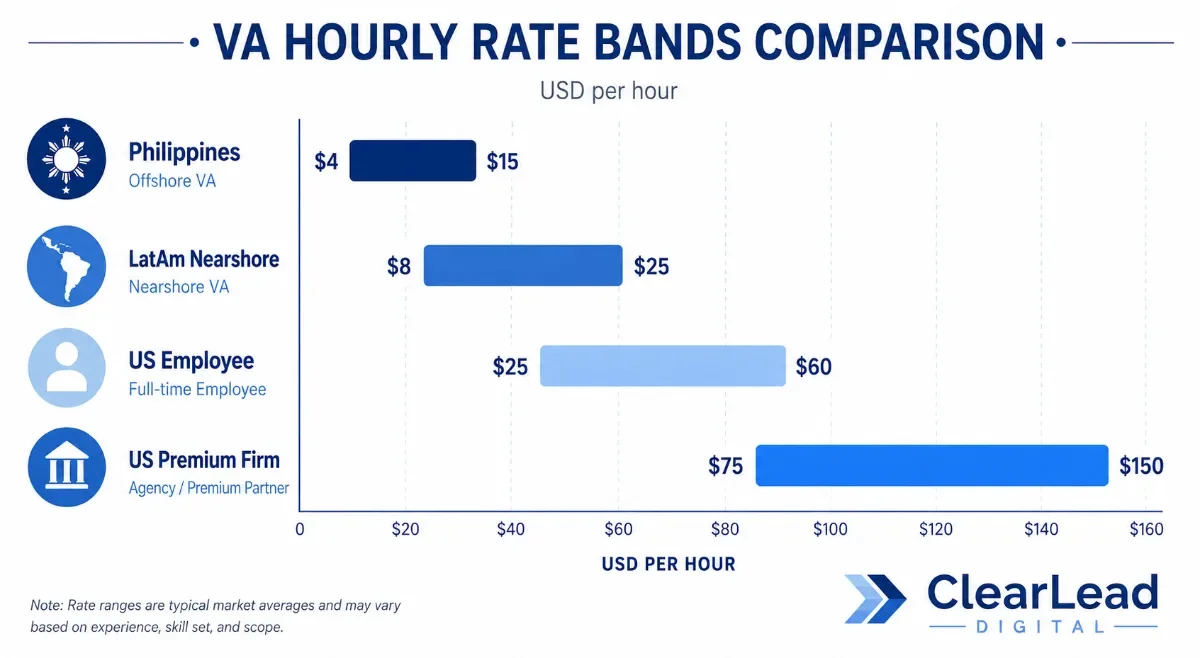
Cost is where most articles get vague. Here are the actual bands operators are paying this year, and, more importantly, what each band includes.
| Sourcing model | Typical rate | What it includes |
|---|---|---|
| Philippines, direct hire | $4 to $12 per hour | Wages only. You recruit, train, manage, and cover absence. |
| LatAm and Caribbean nearshore, agency | $12 to $22 per hour all-in | Wages plus recruiting, training, supervision, QA, equipment, and a replacement bench. |
| US-based employee | $28 to $48 per hour fully loaded | Wages, payroll taxes, benefits, overhead. You supply management. |
| US premium VA firm | $33 to $65 per hour | Sold in monthly hour blocks, firm-managed. |
For reference, ZipRecruiter puts the US average for a property manager virtual assistant at roughly $21.80 per hour as of August 2026, with most listings between $17.79 and $24.28. That figure is wages only.
The number that actually decides your ROI is not the sticker rate. It is total cost of ownership. Budget for all six of these:
- The hourly or monthly rate
- Additional software seats (your PM platform, CRM, and phone system all charge per user)
- Equipment and a secure connection
- Your training time, which is real and front-loaded
- Turnover and replacement risk
- Supervision, roughly two to four hours a week from someone on your team
A wage-only offshore rate buys you a person. An all-in agency rate buys you a person plus a manager, a QA layer, and a bench when they are sick. If you have never managed remote staff before, the cheap option is usually the expensive one.
Compare that against your revenue per door. If you know your average property management fees and your loaded cost per manager hour, the payback math takes about ten minutes and it is usually obvious.
The delegation map: what to hand off, and in what order
The single biggest mistake operators make is handing a new VA a pile of unrelated tasks in week one. Delegate in tiers, gated on demonstrated accuracy.
Tier 1: delegate in the first 30 days
These are high-volume, low-judgment, easy to audit. If a task can be written as a checklist, it belongs here.
- Inbound leasing inquiry response and prequalification against your written criteria
- Showing scheduling, confirmations, and no-show follow-up
- Application data entry, document collection, and screening report assembly
- Maintenance ticket intake, categorization, and routing to the right vendor
- Vendor scheduling, confirmation calls, and completion follow-up
- Invoice coding and bill entry into your property management software
- Delinquency reminder sequences on a fixed schedule
- Lease renewal notice calendaring and first-touch outreach
- Owner and tenant inbox triage with tagging and templated first responses
Tier 2: delegate after 60 days of clean work
These need portfolio context and a track record before you let go.
- Monthly owner report assembly and variance notes
- Bank reconciliation preparation for a licensed reviewer to approve
- Move-in and move-out coordination checklists
- Utility transfers, HOA registrations, and insurance certificate tracking
- Vendor onboarding, W-9 collection, and COI expiration tracking
- Google review request campaigns and response drafting
- CRM hygiene, lead source tagging, and pipeline cleanup
Tier 3: keep in-house, permanently
This is the section other articles skip, and it is the one that keeps you out of trouble.
- Trust account disbursements and any signature authority. A VA can prepare and reconcile. A licensed, bonded person approves and releases funds.
- Lease execution and any negotiation of terms. In most states this is licensed activity.
- Applicant approval and denial decisions. Fair housing rules put the liability on you, and adverse action decisions should never sit with an offshore contractor working from a loose set of instructions.
- Eviction filings and notices. Jurisdiction-specific, time-sensitive, and legally consequential.
- Owner escalations and churn conversations. When an owner is unhappy, that call is a retention event, not an admin task.
- Anything requiring a state license. Check your state's real estate commission rules before assuming otherwise.
Every Tier 1 and Tier 2 task should have a one-page SOP with a decision tree and an explicit escalation trigger: "If X, stop and tag the property manager." A VA without an escalation rule will guess, and guessing is where the risk lives.
How to hire a property management virtual assistant
1. Scope the role from your time audit, not from a job board
Write the actual list of tasks with volumes attached: "roughly 60 maintenance tickets a week, 25 leasing inquiries, 40 invoices." Volume tells a candidate whether the role is real, and it tells you whether you need 20 hours or 40.
2. Decide agency versus direct hire honestly
Direct hire is cheaper per hour and heavier on you. Agency costs more and absorbs recruiting, backup coverage, and performance management. If your team has never managed a remote worker, start with an agency and bring it in-house later once your SOPs exist.
3. Test for the work, not the resume
Skip the interview-only process. Send a paid two-hour test: three real maintenance tickets to categorize and route, five leasing inquiries to respond to, and a batch of invoices to code. You will learn more in two hours than in three interviews.
4. Set up access properly before day one
Named user account, multi-factor authentication, role-based permissions in your PM platform, and a signed confidentiality agreement. Never share a login. If you use an offshore contractor, review the IRS worker classification guidance and have counsel look at your agreement.
5. Assign an internal owner
One person on your team owns the VA relationship: weekly check-in, QA sampling, and escalation. VAs fail most often from neglect, not from incompetence.
The 90-day onboarding plan
For days 1 to 30, pick a single function—usually maintenance intake or leasing inquiry response. Shadow for a week, then let them run it with 100% review. Target 95% accuracy on a scored sample before adding anything new.
Days 31 to 60. Add a second Tier 1 function. Drop review to a 25% random sample on the first function. Start tracking response time and first-touch resolution rate.
Days 61 to 90. Add Tier 2 work. Move to spot-check QA. Run the numbers: hours reclaimed per manager, cost per door of the VA, tenant response time before and after. This is also the point to decide whether you scale to a second VA or restructure the role.
Four metrics tell you if it is working:
- Manager hours reclaimed per week. The whole point. Should be 12+ by day 60.
- First response time on leasing inquiries and maintenance tickets. Should fall, not rise.
- QA accuracy rate on a scored sample of 20 items per week.
- VA cost per door per month. Track it next to your fee revenue per door.
Where a virtual assistant stops and growth begins
Here is the part worth being blunt about. A property management VA solves a capacity problem. It does not solve a demand problem.
If you are at 300 doors and losing 8% of your portfolio a year, a VA lets you service those doors with less friction. It does not put new owner leads in your pipeline. Every operator who has tried to hand their marketing to a general VA has learned the same lesson: posting three times a week on social does not generate property management leads, and it does not move you into the map pack.
Owner acquisition runs on a different engine: technical site health, content that answers owner-intent questions, local authority, reviews, and a site that converts. That is property management SEO, and it is a specialist discipline with its own tooling and its own timelines. A VA is the wrong tool for it, the same way an SEO agency is the wrong tool for coding invoices.
The operators who compound fastest run both at once. Capacity from a VA and structured delegation, so the team can absorb growth without scaling without operational chaos. Demand from a search presence that brings owners to them instead of the other way around. Groups like NARPM are full of companies that nailed one and stalled on the other.

Your VA is built to handle the doors. But who is filling the pipeline?
If you are adding capacity but your owner leads are flat, the bottleneck is visibility, not staffing. See exactly where owner searches in your market are going instead of to you.
Get a Free SEO AuditThe short version
Property management virtual assistants work when you treat them as an operations project, not a hiring shortcut. Audit your time first. Budget for total cost, not the hourly rate. Delegate in tiers with written SOPs and an escalation rule. Keep trust accounting, licensed activity, and fair housing decisions in-house without exception. Measure hours reclaimed and QA accuracy, not vibes.
And keep the two problems separate. A VA buys you capacity. Only demand generation buys you growth.
Frequently Asked Questions
How much does a property management virtual assistant cost?
Expect roughly $4 to $12 per hour for a Philippines-based VA, $12 to $22 per hour all-in for Latin America and Caribbean nearshore talent, and $28 to $48 per hour fully loaded for a US-based hire. ZipRecruiter lists the US average for a property manager virtual assistant at about $21.80 per hour in wages alone, which is before payroll taxes, software seats, and your own management time.
What tasks should a property management virtual assistant handle first?
Start with high-volume, low-judgment work: inbound leasing inquiries, showing scheduling, application data entry, maintenance ticket intake and vendor dispatch, invoice coding, delinquency reminders, and owner report assembly. These are repeatable, easy to script, and easy to audit.
Can a virtual assistant handle trust accounting or sign leases?
No. Anything that touches trust account disbursements, lease execution, eviction filings, fair housing decisions, or licensed activity should stay with a licensed, bonded employee in your state. A VA can prepare and reconcile, but a licensed person approves and signs.
Is an offshore VA better than a US-based one for property management?
It depends on the role. Offshore VAs win on cost for back-office work like data entry, reconciliation, and reporting. Nearshore and US-based VAs win where accent, time zone, and live phone coverage matter, such as leasing calls and owner communication.
Can a property management virtual assistant do my marketing?
A VA can execute tasks like posting, list building, and review requests. A VA cannot build your search visibility. Ranking for owner-intent keywords requires technical SEO, content strategy, and local authority work, which is a specialist discipline, not an admin task.
How long does it take for a property management VA to pay for themselves?
Most operators see payback in 60 to 90 days once the VA is fully ramped. The math is simple: if a VA reclaims 15 hours a week from a manager billing at $45 an hour of loaded cost, that is roughly $2,700 a month in recovered capacity against a $1,200 to $2,600 monthly VA cost.