⏱ 13 Minute Read
Last Updated: May 29, 2026
At a Glance
SEO is one of the highest-ROI marketing channels available to property management companies — when the strategy is built around the right metrics
The four numbers that matter most: cost per lead, cost per door acquired, organic traffic growth rate, and keyword ranking position for revenue-intent terms
A door with a $150/month management fee and a 5-year client relationship is worth $90,000+ in lifetime revenue — your acquisition cost should reflect that math
SEO compounds over time; paid ads stop the moment your budget does — growth-focused PM companies use both
The most common reason PM SEO underperforms: the agency isn't property management-exclusive and the content targets the wrong audience
A simple five-step audit can tell you whether your current SEO investment is working or wasting money
Table of Contents
Why Property Management SEO Is a Different Conversation in 2026
SEO vs. Paid Ads for Property Management: The Real Comparison
How to Calculate Whether Your Current SEO Investment Is Working
The Lifetime Value Argument Every Property Manager Should Make
Frequently Asked Questions About Property Management SEO ROI
Return on Investment (ROI) measures how much profit you generate relative to what you spend. In property management marketing, ROI tells you whether your investment is actually producing more revenue than it costs.
If you've ever wondered whether SEO is actually worth the money, you're not alone. Property management company owners are some of the most numbers-driven business owners in real estate. You track vacancy rates. You watch maintenance cost ratios. You know your gross revenue per door down to the decimal.
So when someone tells you to invest in SEO, your first question is the right one: what's the return?
This post answers that question directly. No vague promises. No buzzword-heavy pitch. Just a clear breakdown of how property management SEO generates revenue, how to measure it, and how to know whether your current investment is working — or wasting your money.
Why Property Management SEO Is a Different Conversation in 2026
Marketing budgets across the property management industry are under more pressure than they've been in years. Rising interest rates slowed acquisition activity. Rental markets cooled in several metros. And owners who had been passively riding market appreciation are suddenly asking harder questions about growth strategy.
At the same time, competition for property management clients hasn't gone away. If anything, it's gotten more concentrated. The companies that invested in digital marketing over the last three years are now pulling away from those that didn't.
SEO is at the center of that gap.
Unlike paid ads, SEO doesn't stop the moment your budget does. A well-ranked blog post, service page, or location page keeps generating traffic, leads, and new business for months or years after it's published. That compounding return is what makes SEO one of the highest-ROI marketing channels available to property management companies — when it's done right.
But "when it's done right" is doing a lot of work in that sentence. Bad SEO produces nothing. Generic content farms and keyword-stuffed city pages aren't moving the needle for anyone. What actually works in 2026 is a strategy built around the metrics that matter to your business.
Let's talk about what those are.
The Core Metrics That Define Property Management SEO ROI
When you're evaluating the return on your SEO investment, four numbers matter more than anything else.
1. Cost Per Lead (CPL)
This is what it costs you to generate a qualified inquiry from a prospective property owner. To calculate it, divide your total monthly marketing spend by the number of owner leads generated that month.
For example: if you're spending $2,000 a month on SEO services and generating 20 qualified owner inquiries, your cost per lead is $100.
Industry context: Google Ads for property management keywords can run $50 to $150 per click — and many of those clicks don't convert. Organic SEO leads typically cost far less per inquiry over a 12-month horizon once the content is established and ranking.
2. Cost Per Door Acquired (CPD)
This is where the real ROI calculation lives. How much did it cost you to add one management unit to your portfolio?
To find this number, take your total marketing spend over a period and divide it by the number of new doors added from marketing-attributed leads.
Example: $24,000 in annual SEO spend ÷ 30 new doors = $800 per door acquired.
Now compare that to what a door is worth. If your average monthly management fee is $150 and your average client stays for 36 months, that's $5,400 in lifetime revenue per door. An $800 acquisition cost against $5,400 in lifetime value gives you a 6.75x return. That's before you account for leasing fees, renewal fees, or any maintenance markup.
3. Organic Traffic Growth Rate
This is a leading indicator — it tells you where your revenue is heading before it gets there. If your organic search traffic is growing month over month, your lead volume will follow. If it's flat or declining, you have a warning sign worth acting on.
Track this in Google Search Console. Look at total clicks and impressions over a 90-day rolling window, not just month-over-month, to smooth out seasonal dips.
4. Keyword Ranking Position for Revenue-Intent Terms
Not all keyword rankings are equal. Ranking on page one for "property management tips for landlords" brings visitors. Ranking on page one for "property management company [your city]" brings clients.
Prioritize tracking rankings for terms with clear commercial intent: city-level service keywords, "how to find a property manager" phrases, and comparison searches like "property management company vs. self-managing."
These are the searches that convert.
SEO vs Paid Ads Comparison
SEO vs. Paid Ads for Property Management: The Real Comparison
A lot of property management owners are caught between two camps. Some are running Google Ads and wondering if SEO is worth adding. Others have invested in SEO and are skeptical of paid advertising.
Here's how to think about it clearly.
Google Ads for property management deliver immediate visibility. If you need leads next month, paid search can generate them. But the economics are brutal if you look at them closely. You're paying per click in a competitive market, and the moment you stop funding the campaign, the leads stop.
SEO takes longer to produce results — typically three to six months before meaningful traffic, and six to twelve months before consistent lead flow from organic search. But once it's producing, the marginal cost of each additional lead drops significantly over time. A blog post that ranks for a competitive keyword can generate owner inquiries for years without any additional spend.
The property management companies winning the most new doors in 2026 aren't choosing one over the other. They're using paid ads to cover the short term while SEO builds the long-term asset base. SEO becomes the engine; paid ads become the accelerant when you need a push.
What Good Property Management SEO Actually Looks Like
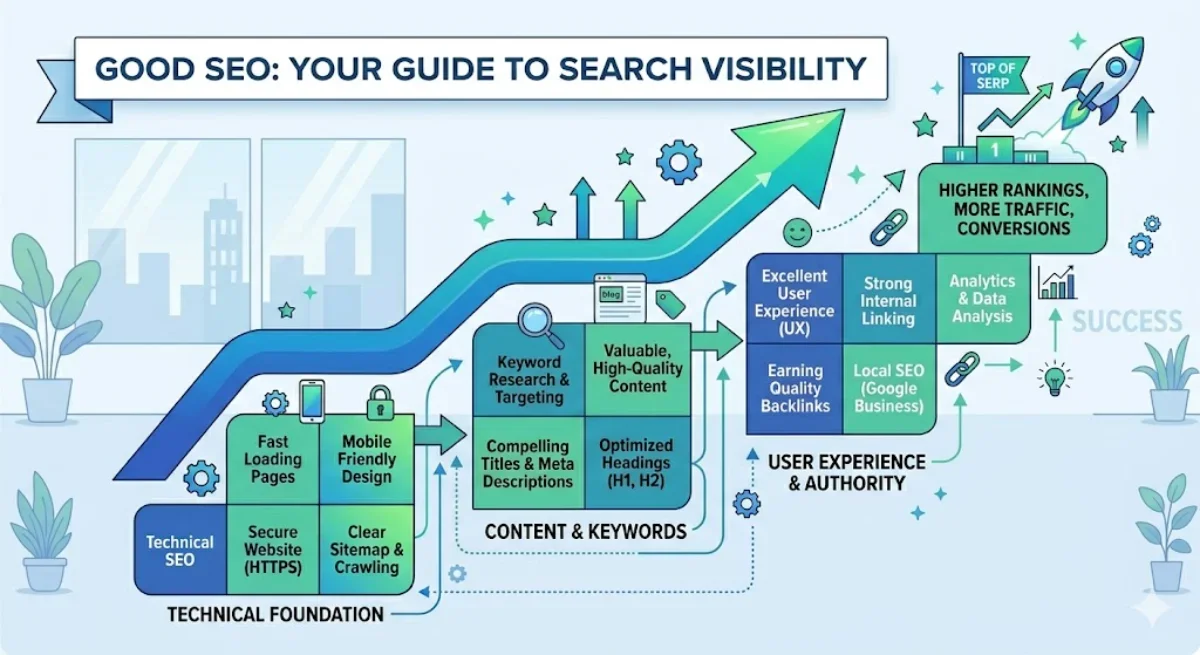
There's a version of SEO that looks busy and produces almost nothing. You get monthly reports full of graphs. Your rankings creep up on keywords nobody searches for. Your traffic grows but your phone doesn't ring.
Here's what separates that from the real thing.
Content That Targets Owner Intent
The most valuable SEO traffic comes from property owners who are actively researching their options. That means your content strategy needs to answer the questions they're actually asking.
Some of the highest-value content categories for PM companies right now:
Comparison content: "Property management company vs. self-managing in [city]" — This captures owners who are on the fence and positions you as the solution.
Process explainers: "How does property management work?" and "What does a property manager do?" — These rank well, build trust, and attract owners early in their decision process.
Cost transparency content: "How much does property management cost in [city]?" — Owners are searching for this. If you answer it honestly, you earn credibility before the first call.
Local market content: Neighborhood guides, rental market reports, and city-specific investment content — These build geographic relevance and attract both owner leads and investor referrals.
Location Pages That Actually Rank
If you serve multiple cities or counties, you need location pages that go beyond plugging a city name into a template. Google's quality signals in 2026 favor pages that demonstrate genuine local knowledge.
That means real market data. Actual neighborhoods. Specific lease regulations in that jurisdiction. Local photography. Testimonials from clients in that area. This is the difference between a location page that ranks and one that sits on page eight.
Technical SEO That Doesn't Leak Traffic
Even the best content strategy underperforms if the technical foundation is broken. Common issues that cost property management companies significant ranking potential:
Duplicate content from auto-generated tag pages or location page templates that are too similar to each other. This dilutes your site's authority instead of building it.
Missing or incorrect canonical tags, especially on sites that have both HTTP and HTTPS versions, or www and non-www versions. Google may be indexing the wrong one.
Slow Core Web Vitals on mobile. Most property owner searches happen on mobile devices. A slow-loading site loses rankings and loses leads.
Thin service pages. If your "Residential Property Management" page is 200 words, you're leaving ranking potential on the table. Competitors with thorough, well-structured pages will consistently outperform you.
Schema Markup for AI Engine Visibility
This is the piece most property management SEO vendors are still not doing in 2026, and it's creating a real opportunity gap.
AI Overviews in Google, responses in Perplexity, and citations in ChatGPT are increasingly pulling from structured content — specifically FAQ schema, Article schema, and local business markup. If your site doesn't use schema markup, you're invisible to a growing portion of how property owners find information.
This isn't complex to implement, but it requires intention. Every FAQ section on your site should have FAQPage schema. Every blog post should have Article or BlogPosting schema. Your contact and service pages should have LocalBusiness schema with accurate NAP data.
How to Calculate Whether Your Current SEO Investment Is Working
If you're already paying for SEO services and you're not sure what you're getting, here's a simple framework to evaluate it.
Step 1: Pull your organic traffic data from Google Search Console. Look at the last 90 days compared to the same period 12 months ago. Is organic traffic up, flat, or down?
Step 2: Identify your top 10 ranked keywords. Are they commercial-intent keywords — city service pages, comparison phrases, owner-intent questions? Or are they informational keywords that attract landlords and renters but not management clients?
Step 3: Trace your last 10 owner leads back to their source. How many came from organic search? If you're not tracking this in your CRM with UTM parameters or a lead source field, start today. You can't optimize what you don't measure.
Step 4: Calculate your cost per door acquired from organic. Divide your last 12 months of SEO spend by the number of new doors you can directly attribute to organic search leads.
Step 5: Compare that number to your lifetime value per door. If your cost per door acquired is less than 20% of your lifetime value per door, your SEO investment has strong ROI. If it's higher than that, something in the strategy needs to change — either the content, the targeting, or the conversion process.
The Math Is Simple: Is Your SEO Actually Paying Off?
If you want to know whether your SEO investment is working, stop looking only at rankings and traffic. Calculate your cost per acquired door and compare it to your lifetime value per door.
Core Formula
Cost Per Door = Total SEO Spend ÷ Organic Doors Acquired
Example SEO Spend
$24,000
Organic Doors Acquired
12
Cost Per Door
$2,000
ROI Benchmark
If your cost per door is less than 20% of your lifetime value per door, your SEO investment is producing strong ROI.
Example: If a client is worth $10,000 over their lifetime, your target cost per acquired door should be $2,000 or less.
What It Means
- Below 20% = strong SEO efficiency
- Above 20% = something needs to improve
- Common issues include weak keyword targeting, poor content strategy, or low website conversion performance
The Lifetime Value Argument Every Property Manager Should Make
Here's the number most PM owners underestimate: lifetime value per client relationship.
The average property management client relationship, when managed well, lasts four to six years. If you manage 10 doors for a client at an average management fee of $150 per door per month, that's $1,500 per month, or $18,000 per year. Over five years, that's $90,000 in management revenue from a single owner relationship — before you count leasing fees, renewals, and any ancillary services.
Now ask yourself: what would you reasonably pay to acquire that client?
Even at a relatively conservative customer acquisition budget of $2,000 to $3,000, the math is overwhelming. And SEO, when it's working, consistently delivers owner leads for far less than that over a 12-month horizon.
The property management companies that understand this calculation invest in SEO aggressively. They're not asking whether they can afford it. They've done the math and they understand they can't afford not to.
Lifetime Value (LTV) is the total revenue a single managed property (“door”) generates over the full duration it remains under management.
Common Reasons Property Management SEO Underperforms
If you've tried SEO before and it didn't deliver, one or more of these is likely why.
The agency wasn't property management-exclusive. SEO strategy for a law firm or an e-commerce brand doesn't translate directly to property management. The keyword research, content angles, conversion paths, and local signals are different. An agency working in 15 industries simultaneously doesn't have the depth to win in yours.
The content targeted the wrong audience. A lot of property management SEO accidentally attracts landlords looking for DIY tips or tenants searching for listings. This traffic looks good in a report but doesn't convert into management clients.
The strategy had no conversion layer. Getting traffic to your site is half the job. If your service pages don't have clear calls to action, trust signals, and a frictionless way to request a consultation, you're generating visitors and losing leads. SEO and conversion rate optimization have to work together.
The timeline expectations were wrong. SEO takes time. If you signed a six-month contract expecting significant lead volume in month two, you were set up for disappointment before the campaign started.
Frequently Asked Questions About Property Management SEO ROI
-
Most property management companies begin seeing measurable organic traffic growth within three to six months of starting a structured SEO campaign. Consistent lead flow from organic search typically develops between six and twelve months. High-competition markets may take longer.
-
Effective property management SEO services generally range from $1,500 to $5,000 per month depending on market competition, scope of work, and whether the agency is property management-exclusive. Be cautious of pricing that seems too low — it usually reflects templated work that won't produce meaningful results in a competitive local market.
-
Ask for monthly reporting that includes: organic traffic trends from Google Search Console, keyword ranking movement for your primary city and service terms, content published that month, and any technical issues identified and resolved. If your agency can't provide this clearly, that's a problem.
-
For long-term lead generation, SEO delivers stronger ROI because the results compound over time and don't stop when your budget does. For immediate lead volume, Google Ads can generate faster results. Most growth-oriented property management companies use both strategically.
-
Start with your core city service keywords — "[city] property management company" and "[city] residential property management." Then build out to comparison phrases, cost-related searches, and neighborhood-specific content. Owner-intent keywords should always be prioritized over general informational terms.
-
Yes. Local SEO levels the playing field significantly. A focused strategy targeting your specific market, with strong location page content, consistent Google Business Profile optimization, and a steady stream of owner-focused blog content, can outrank larger but less targeted competitors.
What to Do Next
If you've read this far, you're thinking about your marketing the right way. Here's where to start.
First, run the five-step audit in the section above. Know your numbers before you change anything.
Second, look at your existing content. Is it targeting owner-intent searches, or is it written for landlords and renters? If it's the latter, you have an immediate opportunity to redirect your content strategy without starting from scratch.
Third, evaluate your agency relationship honestly. Are you getting clear reporting on the metrics that matter? Is your content strategy built specifically for property management, or does it feel like it could belong to any service business in any industry?
If any of those questions surface a gap, that's worth a conversation. ClearLead Digital works exclusively with property management companies. We don't split our focus across industries. Every content strategy, keyword target, and technical recommendation we make is informed by deep experience in how property owners search, what they trust, and what converts them into long-term management clients.
You can request a complimentary SEO review for your property management company.