⏱ 12 Minute Read
Last Updated: May 17, 2026
Most property management marketing advice treats every lead the same. It doesn't. A landlord with three rentals who's exhausted from midnight maintenance calls is worth thousands in annual recurring revenue. A tenant looking for a two-bedroom is not your client — they're your client's client.
The first thing a functioning property management marketing strategy does is draw a hard line between those two audiences. The second thing it does is build a system — not a scattered mix of tactics — that puts your company in front of owners at every stage from "I didn't know this was an option" to "where do I sign?"
This guide covers the full picture: why most PM marketing underperforms, the channels that actually drive owner leads, how to build a property management marketing plan you can execute without an agency, and what to measure so you know it's working.
Table of Contents
Channel 2: Google Business Profile — The Fastest Win Available
Channel 3: Google Ads — Fast Leads, Higher Cost, Worth It When Done Right
Channel 4: Content Marketing — Attract Owners Before They Know They Need You
Channel 5: Reputation Marketing — Reviews Win Deals at the Finish Line
Channel 6: Referral Networks — The Highest-Close-Rate Channel Nobody Builds
Channel 7: Email Marketing — The Nurture Layer Most PM Companies Skip
How to Find Property Management Clients: Putting It Together
Why Most Property Management Marketing Fails
Three patterns come up over and over when I audit PM company marketing:
1. They're targeting the wrong audience
A property management website optimized around "apartments for rent in [city]" is spending its SEO budget attracting tenants. Tenants don't pay management fees. This happens because whoever built the site guessed at keywords or copied what a competitor was doing — without understanding that tenant traffic and owner traffic require completely different pages, different keywords, and different conversion flows.
Don't do this: Don't put "homes for rent" or "apartments for rent" content on your main service pages. It dilutes your owner-acquisition signal and splits your keyword targeting in a way Google penalizes. Tenant content belongs on a dedicated listings section — separate from your core property management marketing pages.
For a full breakdown of property management SEO — including technical setup, keyword targeting, and link building — see our dedicated property management SEO blueprint.
2. They're running tactics without a system
Posting on Facebook, running a Google Ad for three months, sponsoring a local investor meetup, trying Zillow for a quarter — then stopping each one because it "didn't work." The problem isn't usually the channel. It's that there's no consistent follow-up, no clear offer, and no way to measure which touchpoints are actually driving signed management agreements.
3. They're not thinking in funnels
An owner who's never used a property manager needs to be educated before they can sell. An owner who's had a bad experience with another PM company needs trust rebuilt. An owner actively comparing your company to two competitors needs social proof and a clear differentiator. One piece of content or one ad doesn't serve all three. A system does.
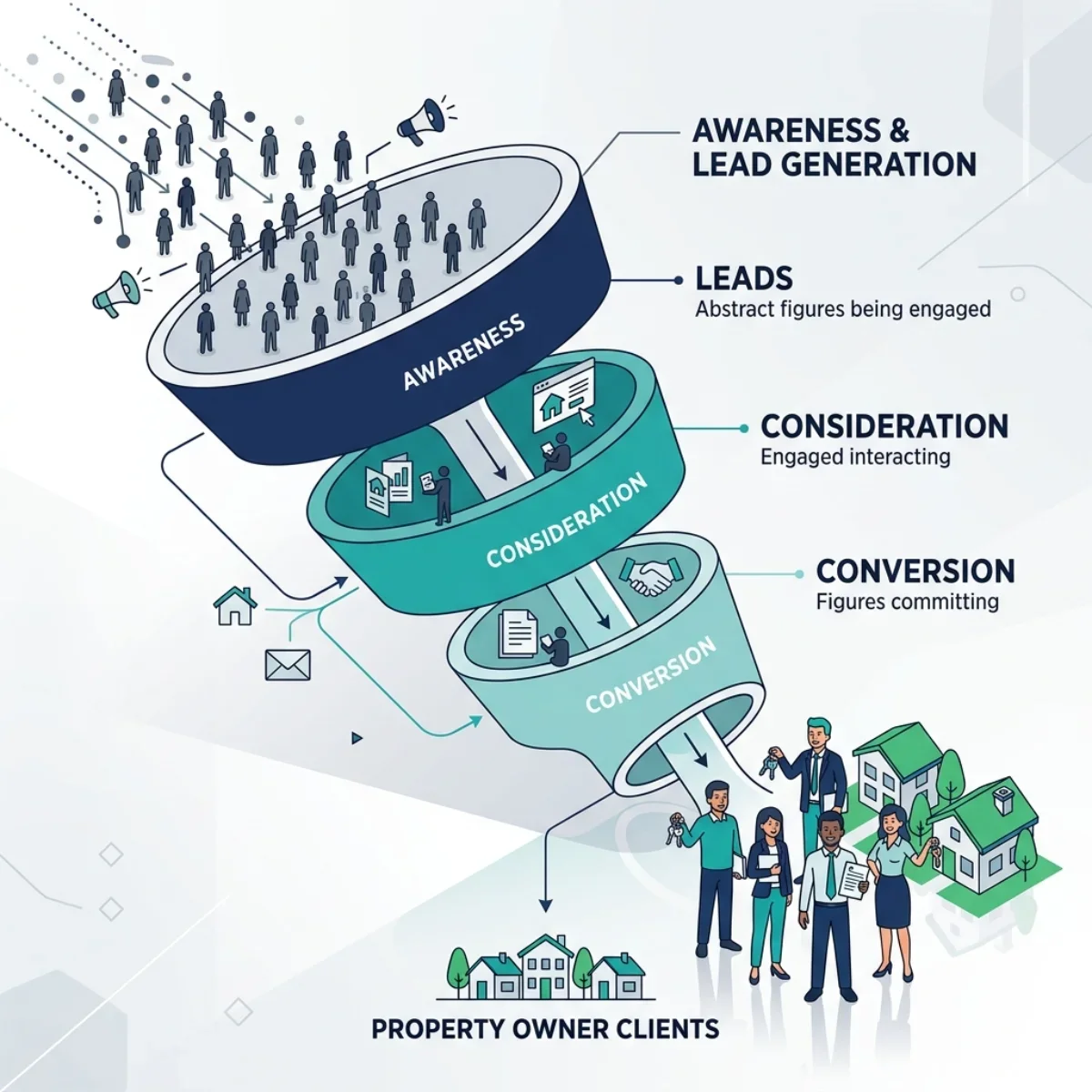
The PM Owner Acquisition Funnel
Before picking any channel, map how your prospects move from strangers to clients. For property management companies targeting landlord leads, the funnel looks like this:
Your marketing plan needs assets at every stage. A company with great SEO but no reviews closes poorly. A company with great reviews but no online visibility never gets found. Both matter.
Channel 1: SEO — The Highest Long-Term ROI Channel
"Property management marketing" gets 1,000 searches per month. "Property management [your city]" gets hundreds more, depending on your market. These are people actively looking for what you sell. SEO puts you in front of them without paying per click — and unlike ads, it compounds over time.
The fundamentals of property management SEO come down to four things:
Homepage — Own Your Primary Local Term
Your homepage H1 should be "[City] Property Management Company" or close to it. Not a tagline. Not your company name. The keyword that someone in your market types when they want to hire a property manager. Put it in the H1, in the first paragraph, in your meta title, and in your meta description.
Location Pages — One Per Market
If you manage properties in multiple cities or neighborhoods, each one gets its own page. Not a bullet point on one page — a full, dedicated page targeting "[city] property management." This is how PM companies that operate across a metro area rank in multiple markets simultaneously.
Service Pages — One Per Service
Tenant screening, lease management, maintenance coordination, accounting — each service deserves its own page. These pages capture searches like "rental property maintenance services [city]" and "tenant screening company near me." They also make your site look like a real company rather than a one-page brochure.
Blog Content — Attract Owners in Research Mode
Blog posts handle the informational search intent — people earlier in the funnel who are researching, not yet ready to hire. The right topics bring in landlords and investors who are one good article away from filling out your contact form. (More on content strategy below.)
For a full breakdown of property management SEO — including technical setup, keyword targeting, and link building — see our dedicated property management SEO guide.
Channel 2: Google Business Profile — The Fastest Win Available
If you had to pick one thing to do this week, it's optimizing your Google Business Profile. The local map pack — those three results that appear with a map when someone searches "property management company near me" — drives a significant portion of all local service business inquiries. And most PM companies have mediocre profiles.
What a fully optimized GBP looks like
Category: Primary category set to "Property Management Company." Add secondary categories for any specialized services (HOA management, vacation rental management).
Description: 750 characters that naturally include your primary keyword, your city, your core services, and what makes you different. Not a mission statement.
Services: List every service you offer using Google's service fields — these feed into search matching.
Photos: At minimum — your office, your team, and properties you manage. Profiles with 10+ photos get significantly more views than those with 1–2.
Q&A: Seed this section yourself with keyword-rich questions and answers. "Do you manage single-family rentals in [city]?" Answer it. "What are your management fees?" Answer it. These show up in search.
GBP Posts: Post weekly — market updates, new listings, tips for landlords. Google rewards active profiles with higher map pack placement.
Key stat: According to Google, businesses with complete Business Profiles are 70% more likely to attract location visits and 50% more likely to lead to a purchase. For property management companies, that typically means an owner phone call, form fill, or direct inquiry from Google Search or Maps.
Channel 3: Google Ads — Fast Leads, Higher Cost, Worth It When Done Right
Google Ads can generate owner leads within 48 hours of launching a campaign. It's the only channel that works that fast. The tradeoff is cost — CPCs for property management terms range from $8–$25 depending on your market — and the leads stop the moment you stop paying.
Used correctly, Google Ads is a great short-term lead source while your SEO builds. Used incorrectly, it burns through budget with nothing to show for it.
Bid on owner acquisition keywords only
Target: "property management services [city]," "property management company near me," "hire a property manager," "rental property management [city]," "property manager for my rental." These signal owner intent.
Don't do this: Don't bid on "apartments for rent" or "homes for rent." These are tenant keywords. You'll pay $10+ per click for traffic that will never hire you. Add tenant-intent terms as negative keywords from day one.
Send ads to a dedicated landing page
Don't send Google Ads traffic to your homepage. Build a dedicated landing page with a single CTA — typically "Get a Free Management Quote" or "Schedule a Consultation." Remove navigation links so there's nowhere to go except convert or leave. This alone can double your conversion rate.
Track calls, not just clicks
Set up Google Ads call tracking and Google Analytics conversion goals before you spend a dollar. If you don't know which keywords are driving phone calls and form fills, you're flying blind. Most PM companies running ads without conversion tracking are wasting 30–50% of their budget on keywords that don't convert.
Channel 4: Content Marketing — Attract Owners Before They Know They Need You
A landlord who Googles "is it worth hiring a property manager" and lands on a well-written article on your site is a warm prospect. They've self-identified as someone evaluating your service. That's what content marketing does for a PM company — it creates touch points with owners at the earliest stage of their decision process.
Owner-focused topics that attract landlord leads
"How much does property management cost?" — Commercial investigation, high intent
"Is hiring a property manager worth it?" — Decision-stage content
"How to find a property management company" — Evaluation-stage content
"Property management tips for landlords" — Awareness stage, builds trust
"How to start a property management company" (1,600/mo) — Reaches investors considering self-management vs. outsourcing
"How to get more rental property clients as a PM company" — Attracts your actual target reader
"What to look for in a property management contract" — Decision stage for owners comparing companies
"Average property management fees by state" — Comparison research phase
Topics that look relevant but attract the wrong audience
"How to find apartments for rent" — Tenant content
"Best neighborhoods to rent in [city]" — Tenant content
"Section 8 housing availability" — Unless you specialize in Section 8 management
Generic "real estate tips" content — Too broad, attracts mixed audience
The rule is simple: before publishing any piece of content, ask "who is searching this, and can they become a management client?" If the answer is no, skip it.
Channel 5: Reputation Marketing — Reviews Win Deals at the Finish Line
A property owner comparing two PM companies who look similar on paper will read the reviews. Every time. The company with 4.8 stars and 60 reviews beats the company with 4.2 stars and 12 reviews — even if the second company is genuinely better at the actual work.
Reviews and reputation management are part of your property management marketing strategy, not a bonus. Here's how to build them systematically:

Ask at the right moment
The best time to ask for a review is immediately after a win — a tenant placed quickly, a maintenance issue resolved fast, a rent collection problem handled smoothly. Don't send a mass email asking for reviews. Send a personal text or email to a specific owner referencing the specific thing that just went well. That context makes reviews 3–4x more likely to happen.
Make it frictionless
Send your Google review link directly — don't make owners hunt for it. Create a shortened URL that goes straight to your Google review dialog (e.g., g.page/[your-business]/review) and put it in every post-win follow-up.
Respond to every review
Every positive review gets a thank you that mentions your city and services — Google indexes review responses, so "Thank you for trusting us with your [city] rental property" is a keyword signal. Every negative review gets a professional, de-escalating response that doesn't argue. Prospective clients read how you handle complaints more carefully than the complaint itself.
Channel 6: Referral Networks — The Highest-Close-Rate Channel Nobody Builds
Referrals close at a dramatically higher rate than any other lead source because someone the prospect already trusts has already done part of the selling for you. A landlord referred by their real estate agent calls you having already heard you're good. That's a fundamentally different sales conversation.
For property management companies, the best referral sources are:
Real Estate Agents
Agents regularly work with investors and landlords. When a buyer client mentions they're keeping their current home as a rental, a well-placed referral relationship means your name comes up. Build this through: attending local real estate association events, co-hosting investor-focused webinars with agents, and sending regular market updates that agents can share with their investor clients.
Real Estate Investors and Investment Groups
Local real estate investment associations (REIAs) are rooms full of your target clients. Become a regular — not as a vendor, but as someone who adds value. Offer to present on property management topics, share market data, or host a Q&A. When investors in the room need a PM company, you're the one they already know.
Title Companies and Real Estate Attorneys
These professionals work with investors at the point of purchase — exactly when owners are deciding how they'll manage the property. A relationship with a title company rep means your name gets mentioned during closings of investment properties.
Your Existing Clients
The most underused referral source in PM is the current client base. Build a simple referral program: for every owner a client refers who signs a management agreement, the referring client gets one month's management fee waived or a gift card. Make the ask explicit — "We love working with you. If you know any other landlords who could use our help, we'd be grateful for the introduction."
Channel 7: Email Marketing — The Nurture Layer Most PM Companies Skip
Not every owner who finds your website is ready to hire today. A landlord who's been self-managing for five years might need six months of touch points before they're ready to hand over their property. Email marketing is how you stay in front of them without spending money on ads every month.
What to send
Monthly market update: Local vacancy rates, average rental prices, notable changes in landlord-tenant law. Positions you as the market expert, not just a vendor.
Owner-focused tips: "Three things to do before listing your rental," "How to handle a tenant who stops paying rent," "What the new local inspection requirements mean for landlords." Practical, specific, valuable.
Case studies: "We placed a tenant in 11 days for an owner who'd had a vacancy for three months." Proof-of-performance content that does passive selling.
Build the list
Put a lead magnet on your website — a free rental property checklist, a local market report, a guide to screening tenants. Gate it behind an email capture. The people who download it are landlords or aspiring landlords — exactly your audience.
How to Build Your Property Management Marketing Plan
A property management marketing plan doesn't need to be a 40-page document. It needs to be specific enough that you could hand it to someone and they'd know what to do every week. Here's a practical framework for a PM company operating in one or two markets:
PM Marketing Plan Template
Define your target client profile
How many doors does your ideal client own? (single property vs. 5–20 unit portfolio)
What's their biggest pain point? (vacancy, maintenance headaches, tenant issues, time)
Where do they spend time online and offline?
Set your monthly lead target
How many new management agreements do you want per month?
What's your current close rate on qualified leads? (Start tracking this now.)
Work backward: if you close 1 in 5 leads, you need 5 qualified leads for every new client.
Prioritize channels by stage
Month 1–3: GBP optimization, homepage SEO, Google Ads (if budget allows), referral outreach to agents
Month 3–6: Location pages, service pages, review-gathering system, REIA participation
Month 6–12: Blog content, email newsletter, case studies, deeper link building
Set a weekly execution rhythm
Monday: Post to Google Business Profile
Tuesday: Follow up with any referral contacts or leads in the pipeline
Wednesday: Publish or update one piece of content
Thursday: Ask one current client for a Google review
Friday: Review the week's leads — where did they come from?
Assign ownership
Who runs Google Ads? Who posts to GBP? Who writes blog content?
If it's all you, pick the two highest-impact activities and do those consistently before adding more.
Set a quarterly review cadence
Every 90 days, look at the numbers (below) and adjust channel spend.
Measuring What's Working: KPIs for PM Marketing
"We're getting more calls" is not a KPI. It's an impression. You need numbers attached to sources so you know which channels to invest more in and which to cut. Here are the metrics every PM company should track:
Review these monthly at minimum. The single most common marketing mistake PM companies make is continuing to spend on channels that aren't producing because they never measured them in the first place.
How to Find Property Management Clients: Putting It Together
The companies consistently growing their door count aren't running one channel well — they're running multiple channels that reinforce each other. SEO brings in inbound leads. Google Ads fills the pipeline while SEO builds. The GBP converts the local searchers. Reviews close the undecided. Referrals bring in the pre-sold.
If you're starting from scratch, here's the order of operations:
Get your GBP optimized this week. It's free, it's fast, and it has immediate impact on map pack visibility.
Fix your homepage SEO this month. Make sure "[city] property management" is in your H1 and meta title. This is the foundation everything else builds on.
Start Google Ads with a focused budget. $500–$1,000/month targeting owner-intent keywords in your city. Track calls.
Build your referral network in parallel. Contact five agents or investors per week. This has zero media cost and the highest close rate.
Add content and email consistently. One blog post per month targeting owner-focused keywords. One email per month to your list.
Six months of consistent execution on this framework produces compounding results. Most PM companies give up at month two.
Frequently Asked Questions
-
The most effective PM marketing strategy combines local SEO, Google Business Profile optimization, and a referral network built around real estate agents and investors. SEO drives inbound owner leads at the lowest long-term cost. GBP optimization is typically the fastest win. Referrals close at the highest rate. Most growing PM companies run all three simultaneously.
-
Property management companies get owner clients primarily through organic search (SEO), Google Business Profile, paid search (Google Ads), and referrals from agents, investors, and existing clients. The most cost-efficient long-term channel is SEO. The fastest channel for immediate leads is Google Ads. The highest-converting channel is referrals.
-
Most PM companies invest 3–7% of gross revenue in marketing. A company at $500K in annual management fees might allocate $15K–$35K per year. That budget typically covers SEO/content (highest ROI over time), Google Ads (fastest leads), and referral/relationship programs. The mix should shift toward organic channels as domain authority builds.
-
Yes — when campaigns are set up correctly. The critical requirement is bidding exclusively on owner/landlord keywords, not tenant keywords. Average CPCs range $8–$25 depending on market competitiveness. Google Ads works best as a short-term lead source while SEO develops long-term organic traffic.
-
The most important KPIs are cost per lead by channel, lead-to-close rate, cost per door acquired, organic keyword rankings, GBP calls and views, and referral source data. Tracking by channel tells you exactly where to invest more and where to cut — which most PM companies never do.
Ready to Build a Marketing System That Actually Produces Owner Leads?
ClearLead Digital specializes in property management marketing — SEO, local search, content, and paid ads built specifically for PM companies that want to grow their door count, not just their web traffic.
We've built organic search systems that put PM companies in position 1 for their primary local terms, structured Google Ads campaigns that generate owner leads at a predictable cost, and content programs that compound in value month over month.
If you want a full audit of where your current marketing stands and a prioritized roadmap to fix it, get in touch with us here. We'll show you exactly what's working, what's wasting budget, and what to do next.