
⏱ 8 Minute Read
Last Updated: November 1, 2026
Florida is one of the best states in the country to start a property management business. Millions of people rent here, investors keep buying, and a lot of owners live out of state and need someone local they can trust. But Florida also has strict rules. If you skip the licensing or mishandle a security deposit, you can lose your license fast.
I have been in Florida real estate and property management since 2012. I hold a Florida real estate license, the NARPM® MPM® and RMP® designations, and I am a past president of the Orlando/Central Florida NARPM chapter. This guide covers how to start a property management company in Florida the right way, step by step.
If you want the national version first, read our full guide on how to start a property management company. This page focuses on what is different in Florida.
Table of Contents
- Do You Need a License to Manage Property in Florida?
- Step 1: Get Your Florida Real Estate License
- Step 2: Become a Broker or Work Under One
- Step 3: Form Your Business
- Step 4: Set Up Escrow and Trust Accounts
- Step 5: Learn Florida Landlord-Tenant Law
- Step 6: Get Insured and Choose Your Software
- Step 7: Set Your Fees
- Step 8: Win Your First Owners
- HOAs, Condos, and Vacation Rentals
- FAQ
Do You Need a License to Manage Property in Florida?
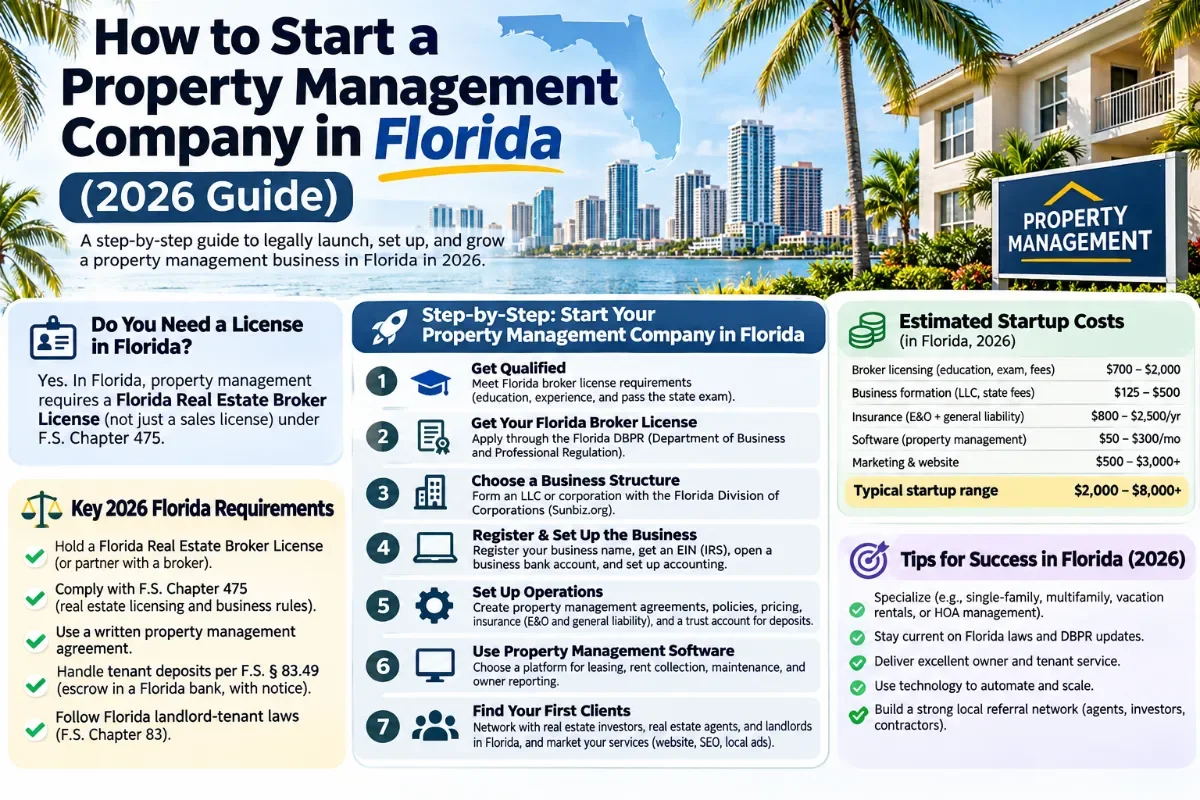
Yes. In Florida, renting or leasing property for someone else in exchange for a fee is real estate activity. Under Chapter 475 of the Florida Statutes, a "broker" includes anyone who rents, leases, or advertises rental property for others for compensation. That means you need a Florida real estate license to run a property management company in Florida.
There are a few narrow exceptions:
- Owners renting their own property.
- Salaried, onsite leasing staff at an apartment community, working for the owner or for a broker.
- Salaried managers of a condo or co-op complex renting units for one year or less.
None of these let you start your own company and charge owners a percentage of rent without a license. If you plan to collect rent, sign leases, or advertise rentals for clients, plan on getting licensed.
Key point: A sales associate license alone is not enough to own and run your own property management company. Sales associates must work under a broker. To run your own shop, you need a Florida broker license or a licensed broker running the company with you.
Step 1: Get Your Florida Real Estate License
Most people start with the sales associate license. Here is the basic path:
- Meet the basics. Be at least 18 and have a high school diploma or the equivalent.
- Take the 63-hour pre-license course from a Florida-approved school.
- Apply with the DBPR (Florida Department of Business and Professional Regulation) and submit fingerprints.
- Pass the state exam.
- Activate your license under a broker.
- Finish 45 hours of post-license education before your first renewal.
Your local REALTOR® association is a great place to start. Many, like Osceola REALTORS® and the Orlando Regional REALTOR® Association, list approved schools and licensing steps on their websites.
Step 2: Become a Broker or Work Under One
To own and operate your own property management firm, you will need a broker license. Florida broker requirements include:
- Experience: At least 24 months as an active sales associate during the past 5 years.
- Education: A 72-hour broker pre-license course.
- Exam: Pass the Florida broker exam with a score of at least 75.
- Post-license: 60 hours of broker post-license education before your first renewal.
If you are not a broker yet, you have two common options. You can work as a property manager under an existing brokerage while you build experience. Or you can partner with a licensed broker who serves as the broker of record for your new company.
Step 3: Form Your Business
Once your licensing plan is set, build the business itself:
- Pick a structure. Most new firms form an LLC. Filing Articles of Organization with the Florida Division of Corporations (Sunbiz) costs $125, which includes the registered agent fee.
- Register the brokerage. Your brokerage entity must be registered with the DBPR so it can legally do real estate business.
- Get an EIN from the IRS so you can open bank accounts and pay staff.
- Get local tax receipts. Most Florida counties and many cities require a local business tax receipt.
- File your annual report. Florida LLCs file an annual report on Sunbiz between January 1 and May 1 each year.
Talk with a Florida attorney and CPA before you file. A one-hour call can save you from the wrong setup.
Step 4: Set Up Escrow and Trust Accounts
This is where many new Florida property managers get into trouble. Money you hold for others, like rent and security deposits, is not your money. Florida brokers must keep these funds in a trust or escrow account at a Florida bank, separate from operating funds.
- Never commingle. Do not mix client funds with your company's operating money.
- Deposit promptly. Florida broker rules require trust funds to be deposited quickly, generally by the end of the third business day after you receive them.
- Reconcile monthly. Brokers must review and reconcile escrow accounts every month.
- Use software built for trust accounting. Good property management software makes this much easier.
Starting a Florida property management company and need a plan to win owners?
Get Your Free Visibility SnapshotStep 5: Learn Florida Landlord-Tenant Law
Florida's residential landlord-tenant rules are in Chapter 83, Part II of the Florida Statutes. Two areas matter most when you are starting out.
Security deposits (Section 83.49)
Florida lets a landlord hold a security deposit in one of three ways:
- A separate non-interest-bearing account in a Florida bank.
- A separate interest-bearing account in a Florida bank, with interest paid to the tenant.
- Posting a surety bond with the clerk of the circuit court.
You must tell the tenant in writing how and where the deposit is held, either in the lease or within 30 days of receiving it. When the tenant moves out:
- If you are not keeping any of the deposit, return it within 15 days.
- If you plan to keep part of it, send a written notice of your claim by certified mail within 30 days.
- The tenant then has 15 days to object.
Miss these deadlines and you can lose the right to keep any of the deposit. Build them into your move-out checklist from day one.
Fair Housing
Federal, Florida, and local fair housing laws apply to every ad, showing, application, and lease. Use written screening criteria, apply them the same way to everyone, and train every person on your team.
Step 6: Get Insured and Choose Your Software
Before you sign your first owner, put these in place:
- Errors and omissions (E&O) insurance to cover mistakes in your professional work.
- General liability insurance for injuries and property damage.
- Workers' comp if you have employees, as Florida law requires for many businesses.
- Property management software for trust accounting, rent collection, maintenance, and owner statements. Compare your options in our guide to the best property management software or our Buildium review.
Step 7: Set Your Fees
Florida property management fees typically run 8% to 12% of collected monthly rent. Most companies also charge leasing, renewal, and setup fees. Your price should reflect your market, your service level, and the types of homes you manage.
| Fee | Common Florida range |
|---|---|
| Monthly management fee | 8% to 12% of collected rent |
| Leasing fee | Often 50% to 100% of one month's rent |
| Lease renewal fee | Flat fee or a small percentage |
| Setup fee | Flat fee per property, or none |
See the full breakdown in our guide to average property management fees.
Step 8: Win Your First Owners
Licensing gets you in the door. Owners keep you in business. In Florida, most owner leads come from:
- Google Business Profile and local search. Owners search "property management near me" and your city name. Our Google Business Profile guide shows you how to set it up.
- Reviews. New companies need a steady flow of real reviews. See our guide to reputation management for property managers.
- Agent referrals. Many agents do not want to manage rentals. Offer to manage their clients' homes and send them back the sale.
- Out-of-state investors. Florida attracts buyers from across the country and abroad. A strong website that builds trust is a must.
- NARPM® membership. Florida has active NARPM chapters across the state. They are one of the best ways to learn, find mentors, and earn referrals.
Put it all on paper with our free property management marketing plan template, and see more ideas in our guide to increasing property management leads.
HOAs, Condos, and Vacation Rentals
Community association management (CAM) license
Managing homeowners associations or condo associations is a different license in Florida. If you manage an association with more than 10 units or an annual budget of $100,000 or more, you generally need a community association manager (CAM) license from the DBPR. Many Florida companies do both rentals and associations, but plan for both licenses if you go that route.
Vacation and short-term rentals
Short-term rentals are big business in Florida, especially around Orlando and the coasts. Vacation rentals generally need a license from the DBPR Division of Hotels and Restaurants, and you must collect Florida sales tax plus any county tourist development tax. Many cities and counties also have their own registration rules. Check local rules before you take on short-term rental clients.
Bottom line: Starting a property management company in Florida takes more setup than in many states, but the rules protect owners, tenants, and you. Get licensed, protect client money, follow the deposit deadlines, and then focus on winning great owners.
Note: This guide is general information, not legal or tax advice. Laws change. Confirm current requirements with the Florida DBPR, a Florida real estate attorney, and a CPA before you launch.
Ready to get found by Florida rental owners? ClearLead Digital was built by property managers for property managers.
See Our Property Management SEO ServicesFrequently Asked Questions
Do you need a license to be a property manager in Florida?
Yes. If you rent, lease, or advertise property for others for a fee, Florida law treats that as real estate activity, so you need a real estate license. To own and run your own property management company, you need a broker license or a licensed broker of record.
How long does it take to start a property management company in Florida?
If you are starting from scratch, getting a sales associate license can take a few months. Becoming a broker requires at least 24 months as an active sales associate within the past 5 years. Forming the business itself can be done in a few weeks.
How much does it cost to start a property management company in Florida?
Costs vary, but plan for licensing courses and exam fees, a $125 LLC filing on Sunbiz, insurance, software, a website, and marketing. Many small firms launch for a few thousand dollars and grow from there.
Can a sales associate start their own property management company in Florida?
Not on their own. A sales associate must work under a broker. A sales associate can manage property for a brokerage or partner with a licensed broker who serves as the company's broker of record.
How fast must a Florida landlord return a security deposit?
If no claim is made, the deposit must be returned within 15 days after the tenant leaves. If the landlord plans to keep part of it, they must send a written notice by certified mail within 30 days.
Do I need a CAM license to manage an HOA in Florida?
Generally yes, if the association has more than 10 units or an annual budget of $100,000 or more. The community association manager license is issued by the Florida DBPR.
