How to Start a Property Management Company (The 2026 Guide)
⏱ 12 Minute Read
Learning how to start a property management company is one of the most direct paths to building a scalable real estate business — and 2026 is a strong year to do it. Rental demand is high, institutional landlords are pulling back in some markets, and independent property managers who run tight operations have a real competitive edge. This guide covers everything you need to go from idea to first management agreement.
What a Property Management Company Actually Does
Before you build anything, be clear on what you're signing up to deliver. A property management company acts as the licensed intermediary between property owners (your clients) and tenants (the residents). You handle the day-to-day so the owner doesn't have to.
Core services typically include:
Tenant placement — marketing the rental, showing the property, screening applicants, and executing the lease
Rent collection — collecting monthly rent, processing payments, and chasing delinquencies
Maintenance coordination — fielding repair requests, dispatching vendors, and overseeing work quality
Lease management — handling renewals, lease violations, and legal notices
Owner reporting — delivering monthly financial statements, annual summaries, and year-end 1099s
Eviction coordination — managing the legal process when a tenancy needs to end
The value you provide is peace of mind. Owners who hire a professional property manager want their investment protected and their time back. When you deliver on that promise consistently, referrals and portfolio growth follow naturally.
According to NARPM, professionally managed rental properties tend to have lower vacancy rates and fewer costly tenant disputes than self-managed ones. Professional management is the better outcome for owners — that’s the case you’ll make every time you pitch a new client.
Do You Need a License to Start a Property Management Company?
Short answer: in most states, yes. Property management licensing requirements vary by state, but the majority require either a real estate broker's license or a dedicated property management license to legally collect management fees on behalf of property owners.
A general breakdown:
Always verify requirements directly with your state’s real estate commission before launching. Practicing property management without the proper license can result in fines, loss of fees, and legal exposure. Do not skip this step.
If you don’t yet hold the required license, your two paths are: (1) get licensed yourself, or (2) partner with a licensed broker who will operate as your designated broker while you handle operations. Many new property management companies start this way.
Step 1: Build Your Business Foundation
Choose Your Business Structure
Most property management companies operate as an LLC (Limited Liability Company). An LLC separates your personal assets from business liabilities — which matters a lot in property management, where disputes over security deposits, habitability claims, and eviction proceedings are part of the job.
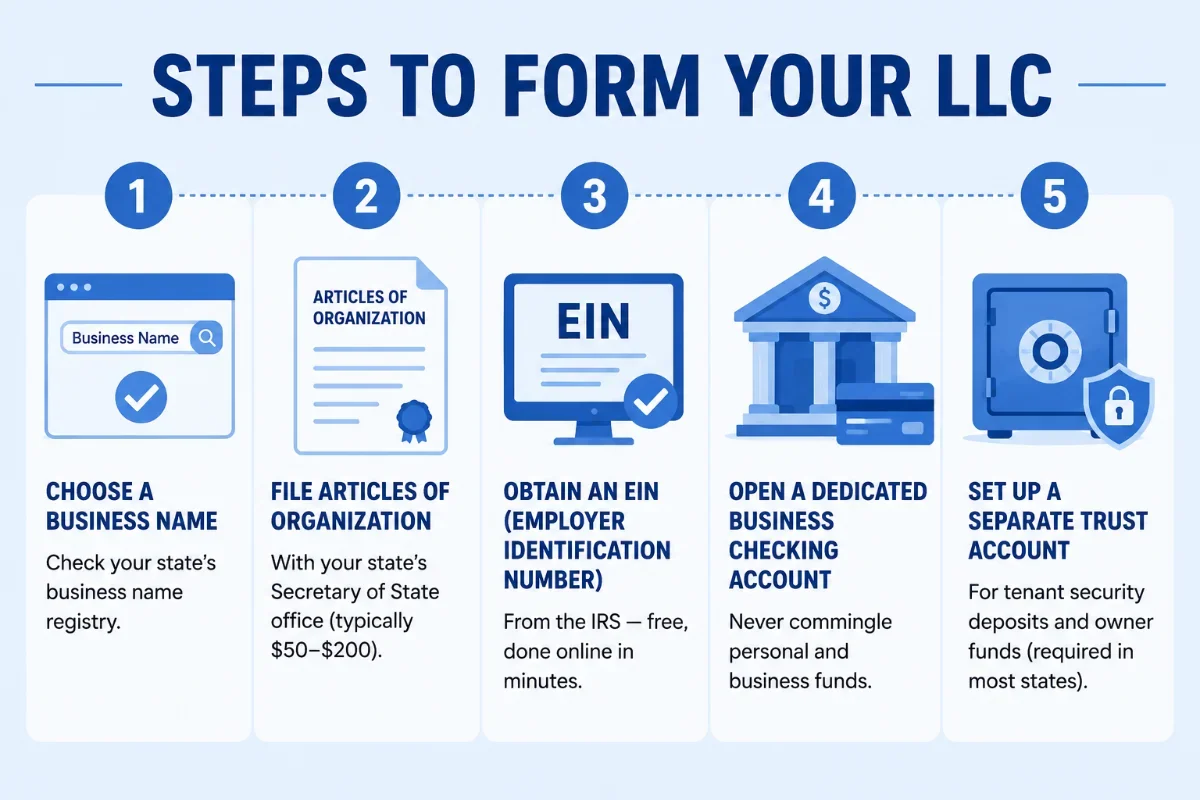
Steps to form your LLC:
Choose a business name (check your state's business name registry)
File Articles of Organization with your state's Secretary of State office (typically $50–$200)
Obtain an EIN (Employer Identification Number) from the IRS — free, done online in minutes
Open a dedicated business checking account — never commingle personal and business funds
Set up a separate trust account for tenant security deposits and owner funds (required in most states)
Work with a real estate attorney when drafting your operating agreement and setting up your trust accounting structure. Getting this right from the start saves significant headaches later. Trust accounting errors are one of the top reasons property managers face license discipline.
Get the Right Insurance
Running a property management business without proper insurance is a serious risk. You're handling other people's money, their tenants, and their properties. The core policies you need:
Errors & Omissions (E&O) Insurance — protects you if a client claims your professional advice or actions caused them financial harm. This is non-negotiable.
General Liability Insurance — covers bodily injury or property damage claims related to your business operations
Workers' Compensation — required once you hire employees; check state thresholds
Fidelity/Employee Dishonesty Bond — covers theft of client funds by you or your employees
Expect to pay $1,500–$4,000/year for a solid E&O + general liability package when you're starting out. That cost goes up as your portfolio grows.
Step 2: Set Up Your Operations
Choose Property Management Software
Your property management software is the operational backbone of your business. It handles rent collection, maintenance requests, owner and tenant communication, financial reporting, and trust accounting. Do not try to run a property management company out of spreadsheets — it doesn't scale and it creates compliance risk.
Leading platforms to evaluate:
AppFolio — industry standard for growing portfolios; best-in-class reporting; minimum unit count requirements apply
Buildium — strong option for smaller portfolios; good onboarding experience; flexible pricing
DoorLoop — modern interface; competitive pricing; good for new operators
Rentvine — gaining popularity for its flexibility and clean owner-facing portals
Propertyware — preferred by larger single-family operators
Budget $100–$400/month depending on portfolio size and the platform you choose. Most offer free trials — test the owner reporting and trust accounting modules carefully before committing.
Build Your Management Agreement
Your property management agreement is the legal contract between your company and every owner client. It defines the scope of services, your fee structure, your authority to spend on repairs, how you handle evictions, and how either party can terminate the relationship.
Have a real estate attorney review your management agreement template before you use it. Key provisions to include:
Management fee structure and when fees are earned
Leasing fee, renewal fee, and any ancillary fees
Maintenance authorization threshold (the dollar amount you can spend without owner approval)
Your liability limitations and indemnification language
Termination notice requirements (typically 30–60 days)
Dispute resolution process
NARPM provides sample management agreement language and legal resources to its members. Joining NARPM early in your launch gives you access to these resources before you’re in a position to make costly mistakes.
Step 3: Set Your Fee Structure
Property management fees vary by market, property type, and service scope. Underpricing is one of the fastest ways to burn out — especially in year one when every task takes longer than expected. Price your services to reflect the value you deliver, not just what the market will bear.
Standard fee types in residential property management:
Be transparent about every fee in your management agreement and your marketing. Owners who understand your fee structure upfront are more likely to stay long-term. Fee surprises are the #1 source of client churn.
Step 4: Get Your First Owner Clients
Landing your first handful of properties is the hardest part. You're asking owners to trust you with their most valuable asset, and you don't have a track record yet. Here's where most successful operators start:
Your First Referral Network
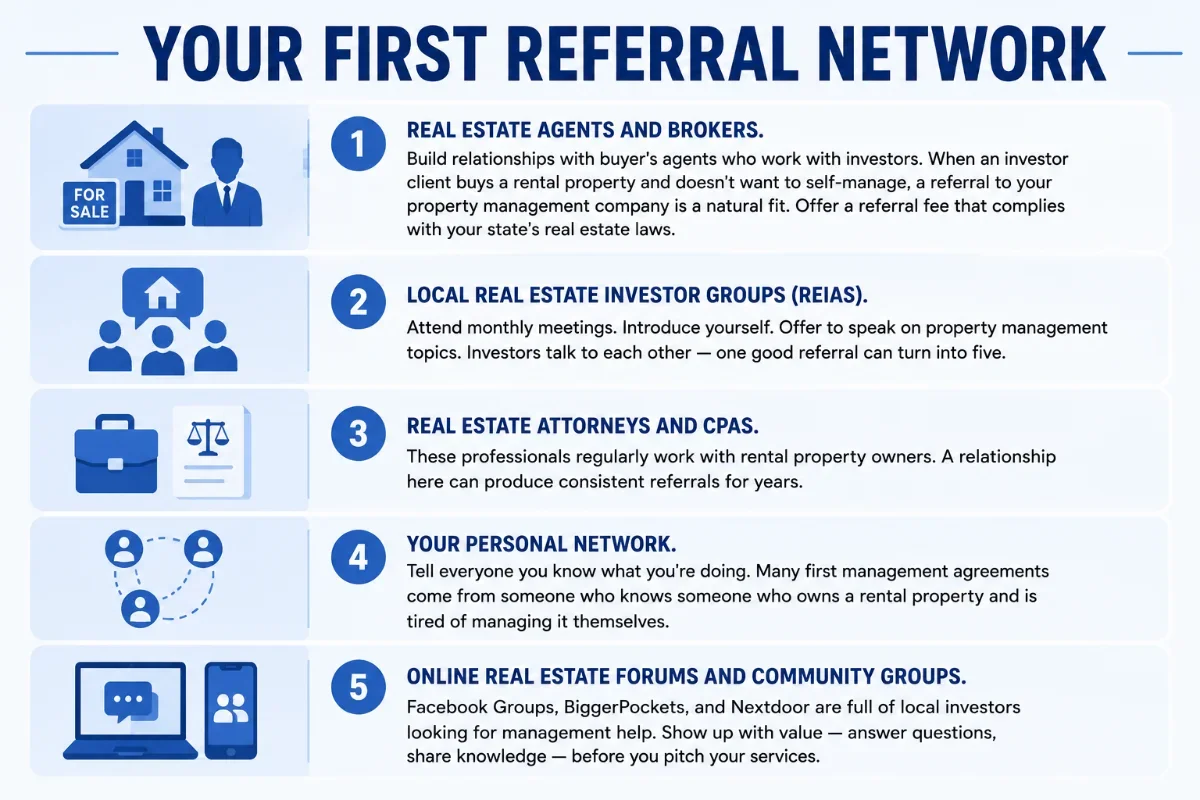
Real estate agents and brokers. Build relationships with buyer's agents who work with investors. When an investor client buys a rental property and doesn't want to self-manage, a referral to your property management company is a natural fit. Offer a referral fee that complies with your state's real estate laws.
Local real estate investor groups (REIAs). Attend monthly meetings. Introduce yourself. Offer to speak on property management topics. Investors talk to each other — one good referral can turn into five.
Real estate attorneys and CPAs. These professionals regularly work with rental property owners. A relationship here can produce consistent referrals for years.
Your personal network. Tell everyone you know what you're doing. Many first management agreements come from someone who knows someone who owns a rental property and is tired of managing it themselves.
Online real estate forums and community groups. Facebook Groups, BiggerPockets, and Nextdoor are full of local investors looking for management help. Show up with value — answer questions, share knowledge — before you pitch your services.
Build a Website That Generates Owner Leads
Referrals will get you started. A professionally designed property management website optimized for local SEO will keep leads coming in consistently over time — without you having to network constantly.
Your website should rank for terms like "[your city] property management company" and "property management company near me." When a property owner in your market searches for management help at 10pm on a Tuesday, your site should show up. That's how you generate owner leads while you sleep.
Essential pages for a property management website:
Homepage — clear value proposition, services summary, and a strong owner-facing CTA
Services page — detail what's included in your management package
Pricing page — be transparent; owners who research online want this information upfront
About page — your background, designations, and why you specialize in this market
Owner resources / FAQ — answers common owner questions and builds trust before the first call
Contact / Get a Quote — make it easy to reach you from any page
SEO for property management is one of the highest-ROI marketing investments a PM company can make. Unlike paid ads that stop the moment you stop spending, a well-optimized website continues to generate owner leads for years. The right keywords and consistent content strategy are what separate PM companies that grow from those that stall.
Google Business Profile
Set up and fully optimize your Google Business Profile from day one. This is free and gives you a chance to appear in the "local pack" — the map results that show up at the top of Google when someone searches for property management companies near them.
Optimization basics:
Choose "Property Management Company" as your primary category
Add your full service list and write keyword-rich descriptions
Upload professional photos of your office and team
Enable messaging so owners can contact you directly from Google
Ask every satisfied client for a Google review — this directly affects your local ranking
Step 5: Join Professional Associations
This is one of the most overlooked steps when starting a property management company — and one of the most valuable. Professional associations exist to help you run a better business, stay legally compliant, and build credibility with owner clients.
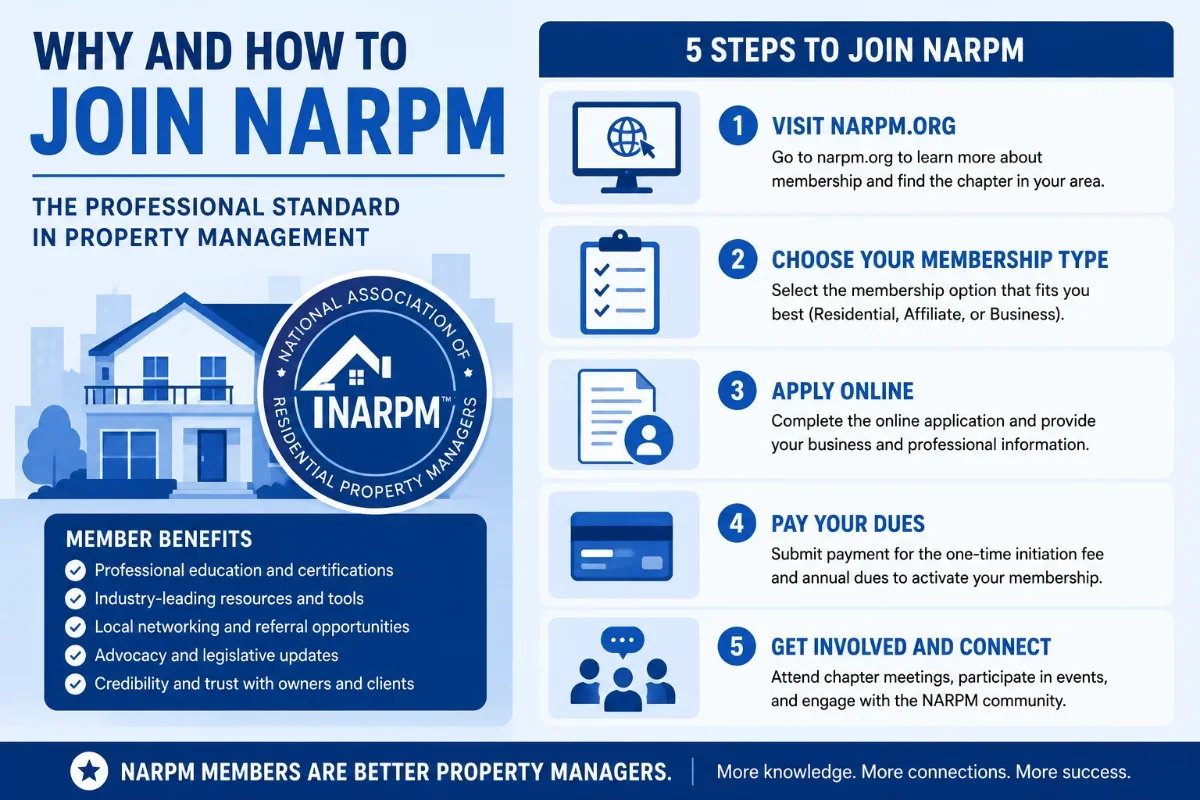
NARPM — National Association of Residential Property Managers
NARPM is the preeminent professional association for residential property managers in the United States. Membership gives you:
Access to industry-standard forms, management agreement templates, and legal resources
Education and training through the NARPM Institute
Professional designations that signal expertise to owner clients
A national network of operators to consult when you hit complex situations
Local chapter events for referral networking
NARPM designations to pursue as you build your business:
RMP® (Residential Management Professional) — requires 2 years of experience and 18 hours of NARPM education. This is your first major milestone.
MPM® (Master Property Manager) — the highest NARPM designation; requires 5 years of experience, 60 hours of education, and additional production requirements. This is the credential that owners and real estate professionals recognize as best-in-class.
Displaying your NARPM designations on your website, email signature, and business materials tells prospective owner clients that you're a credentialed professional — not just another person who decided to manage properties. It matters.
State and Local Associations
Your state apartment association— valuable for legislative updates, lease forms, and compliance training
Local Chamber of Commerce — builds local business credibility and referral connections
Your local Board of Realtors — important if you hold a real estate license; keeps you connected to the agent referral network
BBB Accreditation — a trust signal that matters to some owner clients, especially those doing online research
Step 6: Grow Your Portfolio the Right Way
Once you have your first 10–20 doors under management, the focus shifts from survival to sustainable portfolio growth. The operators who scale successfully don't just wait for referrals — they build systems that generate owner leads consistently.
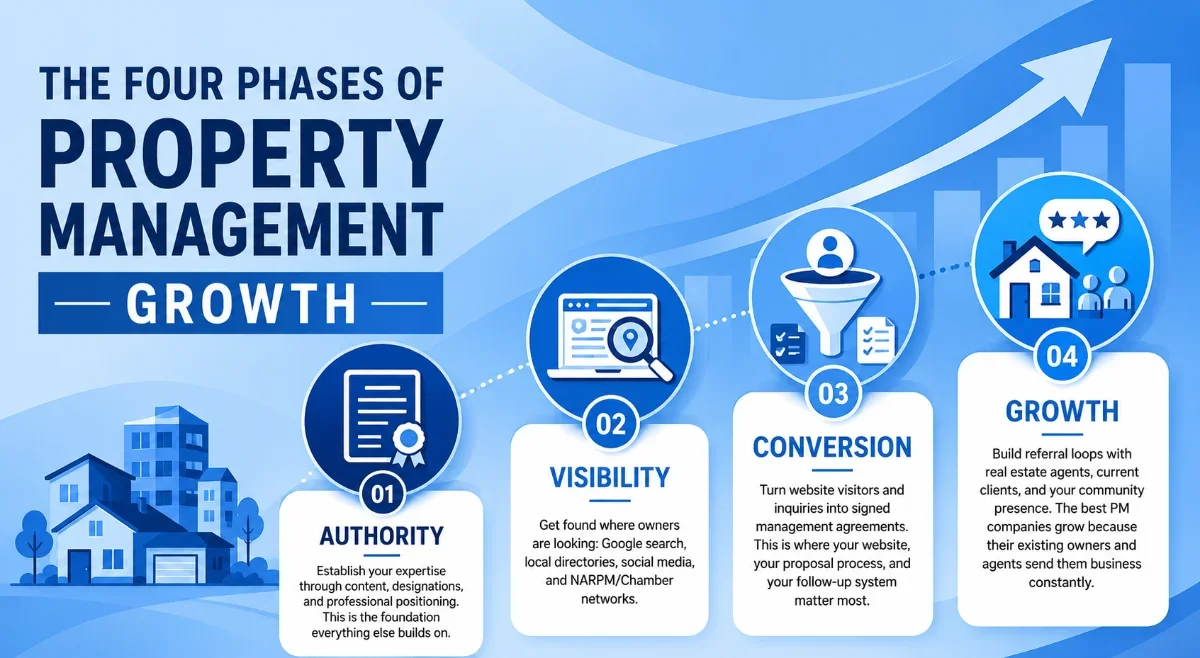
The Four Phases of Property Management Growth
Authority — establish your expertise through content, designations, and professional positioning. This is the foundation everything else builds on.
Visibility — get found where owners are looking: Google search, local directories, social media, and NARPM/Chamber networks.
Conversion — turn website visitors and inquiries into signed management agreements. This is where your website, your proposal process, and your follow-up system matter most.
Growth — build referral loops with real estate agents, current clients, and your community presence. The best PM companies grow because their existing owners and agents send them business constantly.
Content That Attracts Owner Clients
Publishing helpful content on your website — blog posts, owner guides, FAQ pages — does two things at once. It improves your SEO for property management (helping you rank on Google) and it educates prospective clients before they ever call you. Educated prospects convert at a higher rate and have fewer unrealistic expectations.
Topics that resonate with property owners researching management options:
How to evaluate a property management company (red flags and green flags)
What a management agreement should include
How property management fees are calculated
What to expect during the tenant placement process
When is it time to stop self-managing?
If content strategy feels overwhelming on top of running your operations, that's where a property management SEO agency that understands your industry can carry the weight. ClearLead works exclusively with property management companies — we know your buyer, your compliance constraints, and the keywords that actually generate owner leads.
Free ClearLead Resource
Ready to Start Generating Owner Leads?
Download our free property management growth strategy guide — built for operators who are serious about adding doors the right way.
Book a Free Strategy CallFrequently Asked Questions
-
It depends on your state. Most states require a real estate broker's license or a specific property management license to legally manage properties for others and collect fees. A few states — including Idaho, Maine, and Vermont — have minimal requirements. Always check with your state's real estate commission before launching.
-
Startup costs vary widely. You can expect to spend $1,000–$5,000 on licensing and education, $500–$2,000 on business formation and legal fees, $100–$300/month on property management software, and $500–$2,000 on initial marketing. Many operators launch for under $10,000 total.
-
The main revenue source is a monthly management fee, typically 8–12% of collected rent. Additional income comes from leasing fees (50–100% of one month's rent), lease renewal fees, maintenance coordination fees, and sometimes tenant placement fees. Building a strong fee structure from the start protects your margins as you grow.
-
Most new property management companies start with referrals from real estate agents, local real estate investor groups (like your local REIA), and word of mouth. Building a professional website optimized for local SEO — especially for terms like "[city] property management company" — is one of the fastest ways to generate consistent owner leads over time without having to network constantly.
-
NARPM — the National Association of Residential Property Managers — is the gold standard for residential property managers. Joining NARPM gives you access to education, designations like the RMP® and MPM®, industry-standard forms, and a national network of peers. State apartment associations and your local Chamber of Commerce are also worth joining for compliance resources and referral connections.
-
Most operators can have their legal entity formed, software set up, and a management agreement ready in 30–60 days. Getting licensed may take longer depending on your state's requirements and exam schedule. Your first management agreement can realistically happen within 60–90 days of starting the process if you move with intention.
-
For most new operators, Buildium or DoorLoop offer a strong balance of features, ease of use, and cost. If you plan to scale quickly and want the industry-standard platform, AppFolio is worth the higher price point. Avoid managing properties in spreadsheets — trust accounting compliance alone is reason enough to invest in dedicated software from day one.
The Bottom Line
Starting a property management company in 2026 is a real opportunity — but the operators who thrive are the ones who treat it like a professional services business from day one. Get licensed. Get insured. Join NARPM. Build systems. And build a marketing engine that generates owner leads without you having to hustle for every single one.
The property management industry rewards operators who run clean, professional businesses. That means using the right software, executing on your management agreements, staying current on local landlord-tenant law, and continually investing in your education and credentials.
And when you're ready to grow beyond referrals — when you want a steady flow of owner leads from Google without spending a fortune on ads — that's exactly what we help property management companies build at ClearLead Digital.