⏱ 14 Minute Read
Last Updated: July 24, 2026
AT A GLANCE
Most property management companies grow on referrals alone — until they don't
A structured marketing plan is the difference between adding 2 doors a month and adding 20
This guide covers every component of a working plan, with a downloadable template you can use today
KPIs covered: doors added, cost per door, lead source, conversion rate, close rate
IN THIS GUIDE
Most property management companies don't have a marketing plan. They have a collection of things they've tried.
A website they built three years ago. A Google Business Profile someone claimed and forgot about. A Facebook page with fourteen followers. A referral from a real estate agent they met at a NARPM event in 2022. These things aren't a plan — they're accumulated activity without a system behind them.
The website and the Google Business Profile aren't the problem — they're real assets sitting idle, and effective SEO for property management is largely the work of connecting them into something that actually produces owner inquiries.
The companies growing predictably in 2026 — the ones adding 10, 20, 30 doors a year on purpose — share one thing in common: they treat marketing as a system with defined inputs, measurable outputs, and a feedback loop. Not a checklist they run through when business slows down.
This guide walks you through how to build that system from scratch, regardless of whether you're managing 30 doors or 300. At the end, there's a one-page template you can download, fill in, and put to work this week.
1. What Is a Property Management Marketing Plan (And Why Most Companies Don't Have One)?
A property management marketing plan is a written document that answers six questions:
Who are we trying to reach?
What do we want them to do?
Which channels will we use to reach them?
How much will we spend?
How will we convert them from lead to signed agreement?
How will we know if it's working?
That's it. It doesn't need to be 40 pages. The companies I've seen execute best often have a plan that fits on one page — but it's a page they've actually thought through, with real numbers attached to it.
The reason most property management companies don't have one is the same reason most small businesses don't: the owner is busy managing properties, handling maintenance calls, and dealing with tenant issues. Marketing becomes reactive. You run an ad when the phone stops ringing. You update the website when someone complains it looks outdated. You ask a happy client for a Google review when you remember to.
Reactive marketing produces inconsistent growth. Inconsistent growth makes it impossible to hire, train, or build operational capacity ahead of demand. And without operational capacity ahead of demand, every growth spike creates service quality problems that damage your reputation — the most valuable marketing asset you have.
A written plan breaks this cycle.
2. Step 1 — Define Your Growth Goal in Doors, Not Clicks
Every property management marketing plan starts with a number. Not a vague aspiration — a specific, time-bound door target.
Wrong: "We want to grow this year."
Right: "We want to add 24 management agreements by December 31, 2026 — 2 new doors per month."
The reason you start with doors rather than traffic, followers, or impressions is that doors are what actually move your revenue. Everything else is upstream of that number. Once you have a door target, you can work backward through the funnel.
The door acquisition math:
If your goal is 2 new doors per month, and your current lead-to-close rate is 25% (meaning 1 in 4 owner inquiries becomes a signed agreement), you need 8 qualified owner inquiries per month. If your website converts at 3% of visitors to a contact form submission, you need roughly 267 website visitors per month from owner-intent search queries. That's a meaningful but achievable target for a company investing in local SEO.
Getting to that traffic number reliably is the whole job of a structured property management SEO program — ranking for the owner-intent queries that feed the top of this funnel, not chasing vanity traffic that never converts to a signed agreement.
Do this math for your actual conversion rates — not industry averages. Pull your last 12 months of inquiry and close data if you have it. If you don't have it, establishing that tracking system is itself a first-month priority.
Setting your door target:
Start by identifying your current base. How many management agreements are you managing today? What's your average monthly churn (agreements lost to owner moves, sales, or cancellations)? Your net growth target needs to account for churn, not just gross additions.
A company managing 80 doors with 5% annual churn loses 4 doors per year to attrition. To net 24 new doors, they need to close 28 gross new agreements. That's the real number to build the plan around.
3. Step 2 — Know Your Ideal Owner Profile
Not all owner-clients are created equal. The owners who are easiest to serve, most likely to refer, and least likely to cancel are a specific type — and your marketing should be calibrated to attract more of them.
Define your ideal owner profile across four dimensions:
Portfolio size. Are you targeting investors with 1–3 properties, operators with 10–50, or institutional owners with 50+? Each requires a different marketing message, different channel mix, and different sales conversation. Most growth-stage property management companies are best served by targeting owners in the 1–5 property range — enough scale to be worth the relationship, not so large that they require custom pricing and dedicated support you can't yet provide.
Property type. Single-family residential, small multifamily, vacation rental, and commercial each have distinct needs, risk profiles, and marketing channels. If you specialize, say so explicitly in your marketing. "We specialize in single-family residential in Jacksonville” attracts better-fit clients than "we manage all property types."
Owner situation. The most convertible owner leads are accidental landlords (people who inherited a property or moved and couldn't sell), out-of-state investors, and operators who've outgrown self-management. Each has a different pain point and entry message. Accidental landlords need reassurance. Out-of-state investors need trust signals. Self-managing operators need ROI justification.
Motivation. Are they growth-oriented (want to add doors), stability-oriented (want reliable income from existing properties), or exit-oriented (want to eventually sell)? Growth-oriented owners are the most valuable long-term relationships — they add doors to your portfolio as they acquire new properties.
Once you've defined your ideal owner profile, every piece of marketing copy — your website homepage, your Google ads, your follow-up email sequence — gets filtered through one question: does this resonate with that specific person?
4. Step 3 — Audit Your Current Lead Sources
Before you add any new marketing channels, understand where your current business comes from. Pull 12 months of closed agreements and tag each one with a lead source.
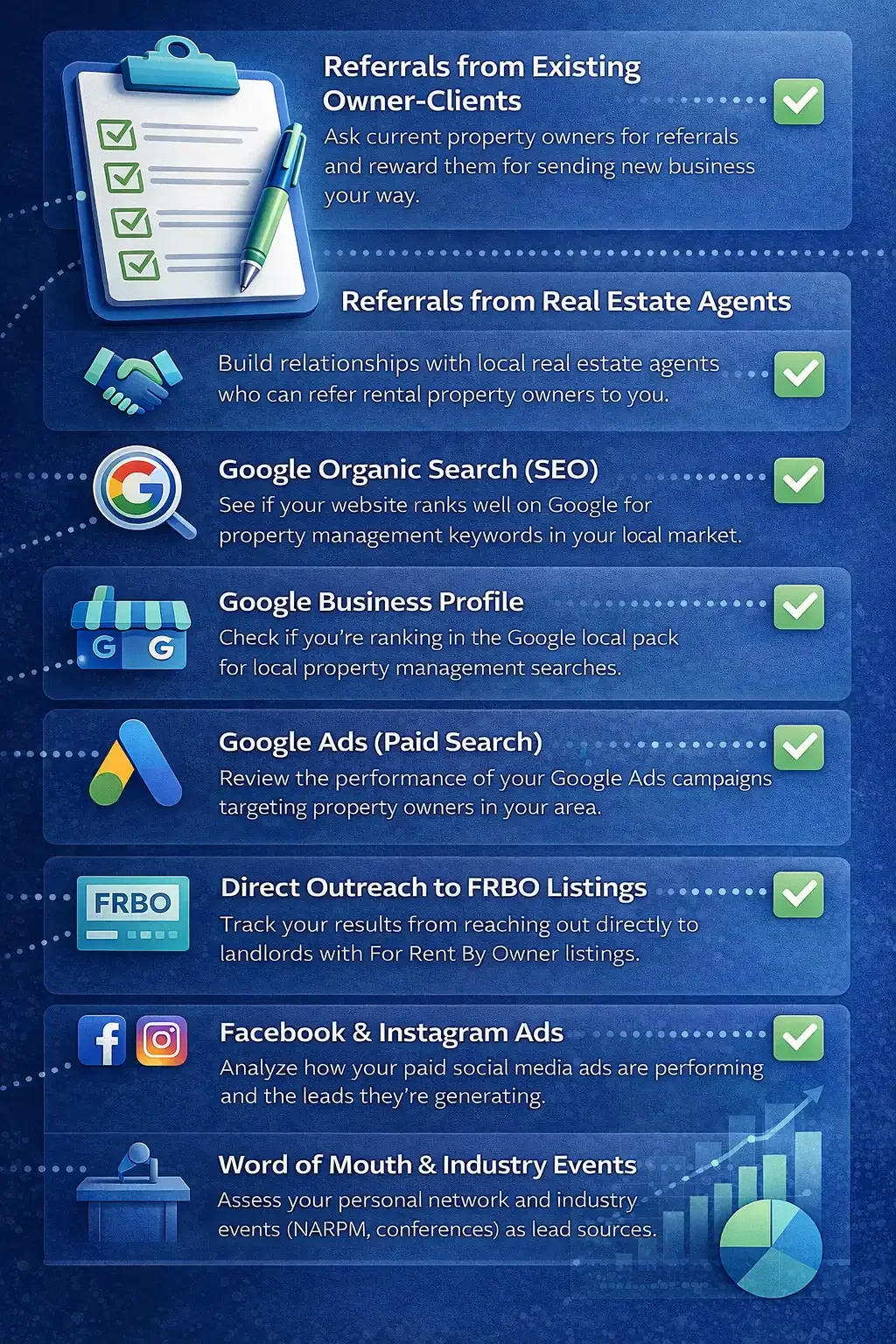
The most common lead sources for property management companies are:
Referrals from existing owner-clients
Referrals from real estate agents
Google organic search (SEO)
Google Ads (paid search)
Direct outreach to FRBO (for rent by owner) listings
Facebook / Instagram ads
Word of mouth / personal network
Industry events and NARPM
Map your actual revenue to actual sources. Most companies, when they do this honestly for the first time, discover that 80% of their business comes from 2–3 sources — and several channels they've been paying for or spending time on are producing nothing measurable.
This audit does two things. First, it tells you what's already working that you should double down on. Second, it identifies the gaps — particularly whether you have any inbound digital channels producing leads, or whether you're entirely dependent on referrals and outbound activity.
The goal of a marketing plan is not to add more channels. It's to make your best channels work harder, and systematically add one new channel at a time until your lead pipeline is predictable and diversified.
- Define your door target for the next 12 months — a specific number, not a range
- Tag and attribute your last 12 months of closed agreements by lead source
- Confirm your Google Business Profile is claimed, complete, and has ≥15 reviews
- Set up a CRM pipeline with lead source tracking before you spend on ads
5. Step 4 — Choose Your Channel Mix by Company Stage
Different marketing channels work differently depending on where your company is in its growth journey. Here's a practical framework for allocating effort across three stages:
Stage 1: Early (0–50 doors)
At this stage, speed to lead matters more than inbound volume. You need clients now, and organic channels take 3–6 months to produce results. Your channel mix should be roughly 70% outbound, 30% inbound foundation-building.
Priority channels:
Direct outreach to FRBO listings (fastest path to owner conversations)
Referral activation with your personal network and real estate agents
Google Business Profile setup and review generation (free, high ROI)
Basic website with clear owner-facing CTA and contact form
Avoid at this stage: Heavy paid advertising before you have conversion infrastructure. You'll spend money sending traffic to a website that isn't built to convert.
Stage 2: Growth (50–150 doors)
You have enough clients to generate referrals systematically, and enough revenue to invest in inbound channels. Your channel mix shifts to roughly 50% outbound, 50% inbound.
Priority channels:
Local SEO (ranking for "[city] property management" and related terms)
Structured referral program (not just asking — a system with incentives and follow-up)
Content marketing (blog posts targeting owner-intent keywords)
Google Ads for high-intent keywords if budget allows
Email nurture sequences for leads who don't close immediately
Stage 3: Scale (150+ doors)
At scale, inbound should be your primary driver. You're investing in brand authority, multi-channel presence, and systems that generate and convert leads without requiring your direct involvement. Your channel mix shifts to roughly 20% outbound, 80% inbound.
Priority channels:
Comprehensive SEO strategy (local, content, technical)
Paid search (Google Ads) with conversion tracking
Meta advertising for owner awareness and retargeting
Reputation management (systematic review generation and response)
Generative Engine Optimization (GEO) — ensuring your brand appears in AI-generated answers
6. Step 5 — Set Your Marketing Budget
The most common question property management owners ask about marketing is: "How much should I spend?" The honest answer is that it depends on your growth goal, your current conversion rates, and your channel mix. But here are practical benchmarks to anchor your thinking.
Revenue-based budgeting:
Most property management companies should allocate 5–10% of gross management fee revenue to marketing. A company generating $25,000/month in management fees should be spending $1,250–$2,500/month on marketing. This includes agency fees, ad spend, tools, and content production — not your own time.
Companies in aggressive growth mode (targeting 25%+ portfolio growth year-over-year) often spend closer to 12–15% of revenue.
Door-based budgeting:
A more precise method: decide what a new management agreement is worth to you and work backwards. If your average management agreement generates $150/month in management fees and stays for 3 years, the lifetime value of one new door is approximately $5,400. A reasonable cost to acquire that client is 15–20% of lifetime value — roughly $800–$1,100 per new management agreement.
If your goal is 24 new agreements this year, your maximum marketing budget is $24,000 for the year — $2,000/month.
Budget allocation by channel:
| Channel |
Early 0–50 doors |
Growth 50–150 doors |
Scale 150+ doors |
|---|---|---|---|
| SEO / Content | 20% | 35% | 30% |
| Paid Search (Google Ads) | — | 20% | 25% |
| Paid Social (Meta) | — | 10% | 15% |
| Tools & Automation (GHL) | 15% | 15% | 10% |
| Referral Program | 30% | 10% | 5% |
| Website & Design | 25% | 5% | 5% |
| Content Production | 10% | 5% | 10% |
| TOTAL | 100% | 100% | 100% |
7. Step 6 — Build Your Conversion System
Generating leads is only half the equation. The companies that add doors consistently are not necessarily the ones generating the most leads — they're the ones converting the highest percentage of the leads they generate.
Your conversion system is the set of processes, tools, and content that moves an owner from "I found this company online" to "I signed a management agreement." It has four components:
Speed to lead. The single variable with the highest impact on conversion rate in property management is how quickly you respond to a new inquiry. Owners evaluating property management companies often contact three to five companies simultaneously. The first company to respond with a personalized, substantive reply wins a disproportionate share of those conversations. A GoHighLevel automation that sends a personalized text and email within five minutes of a form submission — at any hour — is one of the highest-ROI investments a property management company can make.
The initial consultation. Your discovery call or meeting is a sales conversation, not an information session. The best property management companies come prepared with a market analysis for the owner's specific property, a clear explanation of their fee structure, and two or three specific examples of outcomes they've produced for similar owners. This is where your operator-led positioning earns its premium.
Follow-up sequence. Most owner leads do not convert on the first contact. They're evaluating multiple companies, doing their own research, and often waiting for a life event (a tenant moving out, a decision to buy another property) to trigger a final decision. A structured follow-up sequence — five to seven touchpoints over thirty to sixty days — ensures you stay in front of those leads without manual effort. This is what a GoHighLevel pipeline is built for.
Social proof infrastructure. Owner leads research you before they call you. A Google Business Profile with 40 four-and-five star reviews from owner-clients is a conversion asset that works 24 hours a day. Building this systematically — with an automated review request sent to every owner-client at 90 days and annually — is a foundational part of your marketing plan, not an afterthought.
8. Step 7 — Establish Your Reporting Cadence
A marketing plan without a reporting cadence is a document, not a system. You need to know, on a regular schedule, whether your plan is working — and have a process for adjusting it when it isn't.
Weekly (15 minutes):
New leads generated by source
Consultations scheduled
Agreements closed
Response time to new inquiries
Monthly (30–45 minutes):
Leads by source vs. prior month
Cost per lead by channel
Lead-to-consultation conversion rate
Consultation-to-close rate
Doors added, doors lost, net change
Website traffic by source (organic, paid, direct, referral)
Google Business Profile views and calls
Quarterly (1–2 hours):
Progress toward annual door target
Channel ROI (cost per door by acquisition channel)
Ranking progress on target SEO keywords
Pipeline review (leads in follow-up sequence, aging)
Budget reallocation based on performance data
If you're using GoHighLevel, most of this data lives in your pipeline dashboards. If you're not using a CRM, a simple spreadsheet tracking lead source, date, consultation scheduled (yes/no), and outcome (won/lost/nurturing) gives you 80% of what you need to make good decisions.
9. The One-Page Property Management Marketing Plan Template
This template is designed to be filled in and pinned up. One page. Real numbers. Actionable.
PROPERTY MANAGEMENT MARKETING PLAN — [COMPANY NAME] — [YEAR]
GROWTH GOAL Target doors by Dec 31: ___ Current doors under management: ___ Estimated annual churn (doors): ___ Gross new agreements needed: ___ Monthly new agreements needed: ___
IDEAL OWNER PROFILE Property type: ___ Portfolio size: ___ Owner situation (circle): Accidental Landlord / Out-of-State Investor / Self-Managing Operator / Active Investor Primary pain point: ___ Primary market / geography: ___
CURRENT LEAD SOURCE AUDIT Source 1: ___ | % of closed agreements last 12 months: ___ Source 2: ___ | % of closed agreements last 12 months: ___ Source 3: ___ | % of closed agreements last 12 months: ___ Primary gap (channel producing no measurable leads): ___
CHANNEL MIX — THIS YEAR Company stage (circle): Early / Growth / Scale Primary channels (choose 2–3): ___ Secondary channels (supporting): ___ Channel to test this quarter: ___
BUDGET Gross management fee revenue (monthly): $___ Marketing budget (monthly, 5–10% of revenue): $___ Channel allocation:
SEO / Content: $___/mo
Paid Search: $___/mo
Tools / CRM: $___/mo
Referral incentives: $___/mo
Other: $___/mo
CONVERSION SYSTEM Current lead response time: ___ Target response time: Under 5 minutes CRM / automation tool in use: ___ Follow-up sequence in place: Yes / No Review generation process: Yes / No Current Google review count: ___ Target Google review count by year end: ___
KPIs — TRACK MONTHLY Leads generated: ___ Consultations scheduled: ___ Agreements closed: ___ Lead-to-consultation rate: ___% Consultation-to-close rate: % Cost per new door: $ Top-performing channel: ___
QUARTERLY REVIEW DATES Q1: ___ | Q2: ___ | Q3: ___ | Q4: ___
Frequently Asked Questions (FAQs)
-
A complete property management marketing plan should include a specific door growth target, a defined ideal owner profile, an audit of current lead sources, a channel mix appropriate to your company stage, a monthly marketing budget, a lead conversion system, and a reporting cadence. The most effective plans are one to two pages — specific enough to be actionable, simple enough to actually use.
-
Most property management companies should allocate 5–10% of gross management fee revenue to marketing. Companies in aggressive growth mode often spend 12–15%. A more precise method: calculate the lifetime value of one new management agreement and target a cost-per-acquisition of 15–20% of that number.
-
Google Business Profile optimization and local SEO consistently produce the highest-quality owner leads for property management companies, because they capture owners who are actively searching for a management company. Referral programs produce the highest close rates. A well-structured marketing plan combines both rather than relying on one.
-
Outbound channels like FRBO outreach and agent referral activation can produce conversations within days. Google Business Profile optimization typically shows measurable results within 30–60 days. Local SEO and content marketing typically take 3–6 months to produce consistent organic traffic. Paid search produces immediate traffic but requires conversion infrastructure to produce leads efficiently.
-
Track leads by source, consultations scheduled, and agreements closed. Calculate cost per door for each channel by dividing total channel spend by doors acquired from that channel over a given period. This tells you which channels produce the most valuable growth and should receive more budget, and which are underperforming relative to their cost.
-
It depends on your stage. Early-stage companies (under 50 doors) often get more value from learning the fundamentals themselves — basic SEO, GBP optimization, and referral systems — before outsourcing. Growth and scale-stage companies typically see better ROI from a specialized agency because execution quality and speed to results matter more as competition increases.