Locked Into a Franchise Website Platform? How to Win SEO
If you run a franchise location, there's a good chance your website isn't really yours. The franchisor picked the platform. The template came pre-built. The technical settings sit behind a corporate portal you can't fully access. And when you ask your provider to change something, the answer is often a polite version of "that's not available on your plan."
It's one of the most common frustrations we hear from franchise owners: "I want to invest in SEO, but I'm stuck with this website. What can I even do?"
The honest answer is: more than you think — just not where you expect. The trick is understanding which levers the platform takes away, and which ones it leaves wide open. Because in almost every case, the levers that matter most for local ranking are still sitting right there, unused.
What "locked in" actually means
Franchise web providers — platforms built specifically for one industry or brand network — trade flexibility for consistency. That's the whole point. The franchisor wants every location to look on-brand, load a baseline of required features, and stay compliant without each owner reinventing the wheel.
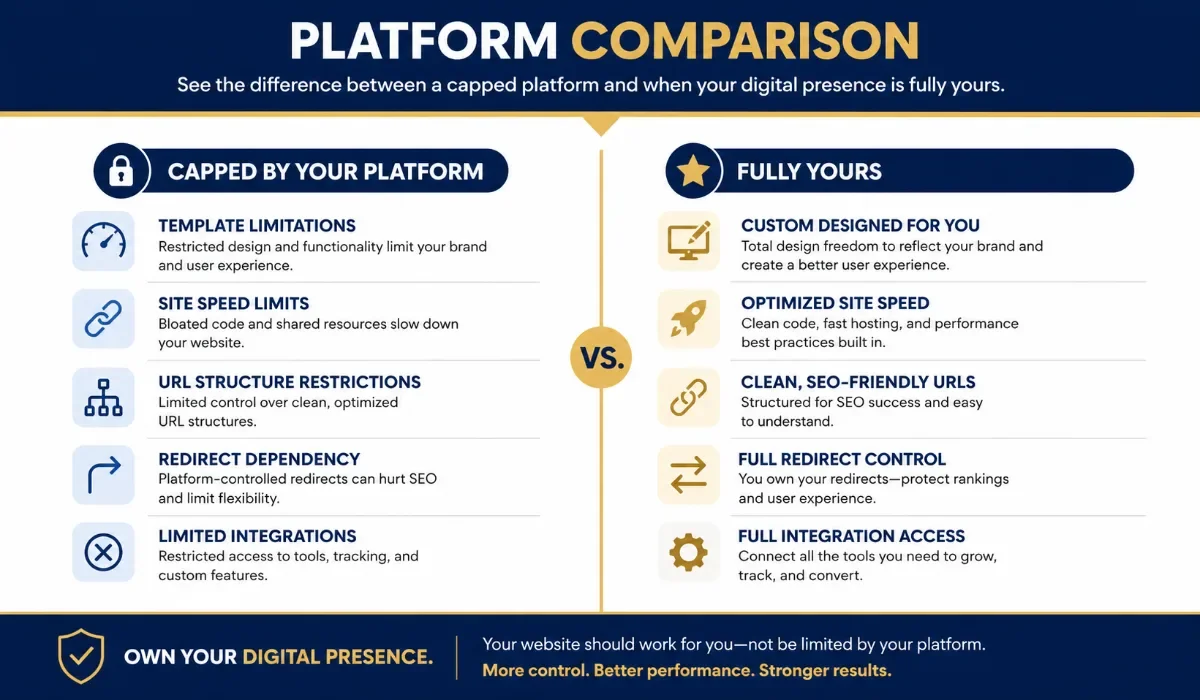
The cost of that consistency is control. On a typical franchise platform, you usually can't touch:
- The overall template, theme, or page layout
- Site architecture and URL structure
- Core technical settings (robots directives, canonical logic, redirects)
- Page speed and hosting configuration
- The site header, footer, and global navigation
- How structured data (schema) gets injected site-wide
If your SEO strategy depends on rebuilding the site, restructuring your URLs, or squeezing out milliseconds of load time, you're going to spend a lot of energy fighting a system designed not to budge.
Don't build your strategy where the platform is locked. Build it where you still have the keys — and for a local business, that's exactly where the biggest wins live anyway.
The mindset shift: technical SEO is capped, content SEO is wide open
Here's the reframe that changes everything for franchise owners.
Search visibility comes from two broad buckets: technical SEO (how well search engines can crawl, render, and trust your infrastructure) and content and on-page SEO (what your pages actually say, how well they match what people search for, and how authoritative they appear).
A franchise platform caps the first bucket. It rarely touches the second.
That matters because for local businesses — the kind most franchises are — content, on-page factors, and your Google Business Profile do the heavy lifting. Nobody is losing the "[service] in [your city]" race because their template loads a tenth of a second slower. They're losing it because a competitor published fifteen genuinely useful, locally targeted pages and they published three vague ones. The platform didn't stop them. They stopped themselves.
The same principle holds in property management SEO — franchise or independent, the operators who win local search are the ones who out-publish and out-specify competitors within the content they actually control.
The levers you actually control
Let's get specific. On a locked-down franchise site, here's where your effort compounds.
1. Your blog is your single best weapon
Your blog is almost always the one area of a franchise site with full editorial freedom. You can publish new posts, write your own titles, edit the body, add images, and set the meta description. That's a lot of runway.
The mistake we see constantly? Franchise blogs get written to sound clever instead of to be found. Titles like "From Due Dates to Direct Deposits: The New Payment Flow Taking Shape in Our City" read nicely — and rank for nothing, because no human being types that into Google.
Same post, new title: "Automated Rent Collection in [City]: How It Works & Why Owners Are Switching." It targets a phrase people actually search, while the content underneath stays identical. Clever can live in the subhead — the title has a job to do.
Write for the questions your customers actually search before they buy: how much does X cost, is X worth it, X vs Y, what to look for in a X. Put your city in the title, the H1, and naturally through the copy — the same fundamentals that make any blog post rank. That's how a local blog earns rankings the generic corporate content never will.
2. On-page basics inside every post and page
Even when the surrounding site is frozen, franchise platforms almost always let you edit page-level on-page details: the title tag, the H1, the meta description, header hierarchy, image alt text, and body copy. These are the fundamentals, and they're yours — a clear title tag, one focused H1, a meta description that earns the click, descriptive alt text, and subheads that map to how people search. No developer access required, just a consistent process.
3. Internal linking
Every blog post is a chance to pass authority to the pages that make you money. When you write about tenant screening, link to your screening service page with descriptive anchor text. When you write about rental profitability, link to your free analysis. Internal linking is free, available on almost any platform, and quietly one of the most underused tactics in local SEO.
4. Your Google Business Profile
Technically this lives off your website — which is precisely why it matters here. Your Google Business Profile is often the single biggest driver of local visibility, and it's 100% in your control regardless of what your web platform allows. Complete every field, pick the right categories, post regularly, add real photos, and keep hours and service areas accurate — all signals Google uses to rank local results.
5. Reviews and reputation
Google reads your reviews — volume, recency, ratings, and increasingly the content. A steady, honest flow of customer reviews strengthens local rankings and conversion at the same time. Again, entirely outside the platform's grip.
6. Schema, where the platform allows it
Many franchise platforms inject a baseline of structured data automatically. You often can't rewrite it, but you can feed it. If your blog editor supports FAQ blocks, using them can trigger FAQ schema and richer search results. Small lever — but it's there, and it's free.
7. NAP consistency and local citations
Here's a lever most franchise owners never think about — and it lives entirely off the platform, so nothing is locked. NAP stands for Name, Address, Phone, and the rule is simple: those three details must appear identically everywhere your business shows up online. Your Google Business Profile, your website footer, Yelp, Apple Maps, Bing Places, your chamber of commerce page, industry directories — all of it.
Why it matters: Google treats consistent NAP as a trust signal that you're a real, established local business. Inconsistencies quietly erode that trust and your local rankings. And they're sneaky — an old suite number, a "Ste." on one listing and "Suite" on another, a tracking phone number that doesn't match your main line, or a location that still lists a previous address. Each mismatch is a small crack in the foundation.
A citation is any online mention of your NAP on another site — those directory listings are your citations. Building consistent, accurate citations across reputable directories strengthens your local authority and feeds the map pack. The playbook is straightforward:
- Audit first. Find every existing listing and note where the NAP drifts. (Clear Lead offers a free NAP audit that surfaces the mismatches for you.)
- Standardize. Pick one exact format for your name, address, and phone — matching your Google Business Profile — and fix every listing to match it.
- Build the core. Claim and complete the major aggregators first: Google, Bing Places, Apple Maps, Yelp, and Facebook.
- Go niche and local. Add industry-specific and local directories (chambers of commerce, local business associations, vertical directories) that reinforce your relevance in your city.
NAP and citations sit completely outside your web provider, so there's nothing to unlock and no ticket to file. It's some of the most reliable local-ranking work you can do on a locked platform. Our full walkthrough lives in Strategies for Local Citation Management, and it pairs directly with local SEO fundamentals. For the underlying principle, Moz has a solid primer on local citations.
What to escalate instead of fight
Some things are genuine technical SEO problems you can't fix yourself — and that's okay. The move isn't to bang your head against the platform. It's to document the problem clearly and push it up the chain. Watch for these and report them to your provider or franchisor:
- Slow page speed or poor mobile performance
- Broken or duplicated canonical tags
- Missing or identical meta data across every location
- Thin, templated location pages with no unique content
If your og:title, og:description, and og:image are blank, every time someone shares your page on Facebook or LinkedIn it renders as a blank card — free visibility leaking out the side. It's shockingly common on franchise platforms. Check yours today.
Here's the practical part: franchisors respond to evidence, not complaints. A vague "our SEO is bad" gets ignored. A short report showing "here's the traffic we're losing, here's the exact fix, here's what a competitor on the same platform is doing" gets action. Frame it as data, and you'll be surprised how much the "locked" platform can actually flex.
The bottom line
Being on a franchise web platform doesn't lock you out of SEO. It locks you out of technical SEO — the infrastructure layer — while leaving the content, on-page, and local-signal layers completely open. And for a local business, that's the layer that decides who wins.
The franchise locations that dominate their local search results aren't the ones with the fanciest platforms. They're the ones who treated the constraints as a given, stopped wishing for a different website, and relentlessly worked the levers they actually had: locally targeted content, clean on-page fundamentals, smart internal links, and a well-fed Google Business Profile. You have those same levers today. The platform can't take them.
Frequently asked questions
Can I do SEO if my franchisor controls my website?
Yes. Franchisors typically control the technical layer — template, structure, site speed — but leave your blog, on-page content, meta data, and internal links open to edit. Combined with your Google Business Profile and reviews, that's enough to compete for local search, even on a locked platform.
What SEO changes can't I make on a franchise platform?
Usually the site template and layout, URL structure, redirects, canonical logic, hosting and page-speed settings, and site-wide schema. These are the technical factors, and they're the ones worth documenting and escalating to your provider rather than trying to fix yourself.
Is blogging actually worth it on a franchise website?
It's usually your single highest-leverage tactic, because the blog is the one area with full editorial control. Locally targeted, search-intent-driven posts consistently outrank the generic corporate content — as long as the titles and on-page elements are written to be found, not just to sound clever.
How do I get my franchisor to fix technical SEO issues?
Lead with data, not frustration. A short report showing the specific issue, the estimated traffic impact, the exact fix, and what a competitor on the same platform is doing gets far more action than a general complaint. Franchisors respond to evidence.
Not sure which levers your platform actually leaves open?
At Clear Lead Digital, we help franchise and local-service businesses squeeze real ranking gains out of platforms that weren't built for flexibility. If you've ever looked at your site and thought "I'm stuck with this," you likely have more room to grow than the platform lets on.