⏱ 11 Minute Read
Last Updated: June 7, 2026
At A Glance
-
~60%
of Google searches now end without a click — AI Overviews answer many of them directly.
-
4
sources is the typical number an AI Overview cites for a local service query.
-
0
paid placements exist in AI Overviews or ChatGPT answers — citations are earned.
-
8–12%
is what AI tools tell owners the “average management fee” is — pulled from pages like this one.
-
Months
not weeks, is the realistic timeline to become a cited source.
In This Guide
Two years ago, a property owner searching for management help typed "property management company near me," scanned the map pack, and called three companies.
Today, a growing share of those owners open ChatGPT and type: "I own two rentals in Orlando. Should I self-manage or hire a property manager, and who's good?"
They get a complete answer — fee benchmarks, pros and cons, and increasingly, specific company names. Whether your company is one of those names has nothing to do with how much you spend on ads. AI assistants don't sell placement. They cite sources they trust.
This guide breaks down exactly how AI Overviews, ChatGPT, and Perplexity choose which property management companies to mention — and the specific changes that get you into those answers.
1. Owners Are Already Asking AI Who to Hire
The shift is measurable from both directions.
From the search side: Google now shows AI Overviews on a large share of informational queries — including the exact questions owners ask before hiring a manager: "what does a property manager do," "average property management fees," "is a property manager worth it." When an AI Overview appears, it sits above every organic result, and a majority of users never scroll past it.
From the assistant side: ChatGPT, Perplexity, and Gemini handle the messy, multi-part questions Google was never great at — "compare flat-fee vs percentage management for a $1,800/month rental in Tampa." These tools browse the live web, synthesize an answer, and cite the pages they pulled from.
We've watched this happen with our own content. Our average property management fees guide generated over 100,000 impressions in 90 days — and a meaningful share of those impressions are AI Overviews quoting our fee benchmarks to owners. When an owner asks an AI "what should I pay a property manager," the 8–12% answer has to come from somewhere. It comes from pages that earned the citation.
Operator Perspective
AI referrals are becoming the new fourth lead channel.
When I managed portfolios at Allegiant Management Group, owner leads came from referrals, the map pack, and organic search — in that order. The new fourth channel is AI referral: an owner who arrives already influenced by a trusted answer.
“ChatGPT mentioned you handle single-family property management in Orlando.”Those leads close faster than almost any other source because the AI already did part of the trust-building before the owner ever reached out.
2. How AI Overviews and ChatGPT Actually Pick Their Sources
Different systems, same underlying logic. Here's the simplified version of what we covered in depth in What AI Does Google Search Use:
How AI Search Systems Find Sources
| System | How it finds sources | What it rewards |
|---|---|---|
| Google AI Overviews | Built on Google’s existing index and ranking systems, supported by Gemini models. | Pages already ranking in the top 10–20, with clear, extractable answers. |
| ChatGPT with Search | Bing’s index, OpenAI’s crawler, and retrievable web content. | Structured pages, recent dates, unambiguous facts, and brand mentions across the web. |
| Perplexity | Its own crawler plus multiple third-party indexes and web sources. | Q&A-formatted content, statistics with sources, and strong topical authority. |
The pattern: AI systems favor content that is easy to retrieve, easy to verify, and easy to quote.
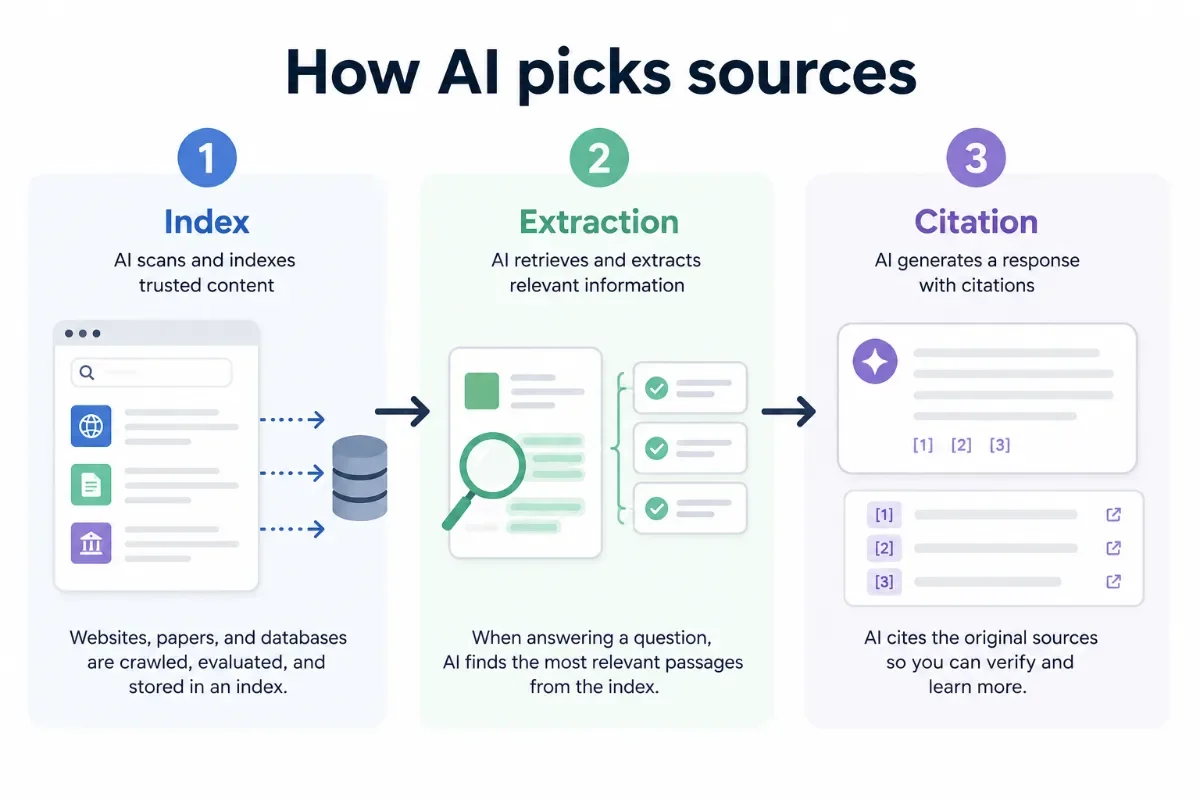
Three things matter across all of them:
Extractability. AI systems lift 40–80 word passages that directly answer a question. A page that buries the answer in paragraph twelve of brand storytelling gives the AI nothing to quote.
Verifiable specifics. "We offer competitive fees" is uncitable. "Our management fee is 9% of collected rent with a 75% leasing fee" is a fact an AI can repeat — with your name attached.
Corroboration. ChatGPT in particular cross-references. A company described consistently on its own site, its Google Business Profile, NARPM's directory, and a few industry mentions gets treated as a real entity. A company that exists only on its own website is a rumor.
Building that consistent footprint is part of a broader property management SEO strategy — the same technical, content, and citation work that earns traditional rankings is what makes a company citable to AI in the first place.
3. The 3 Places Your Company Can Appear in an AI Answer
There are three distinct wins, and they require different work:
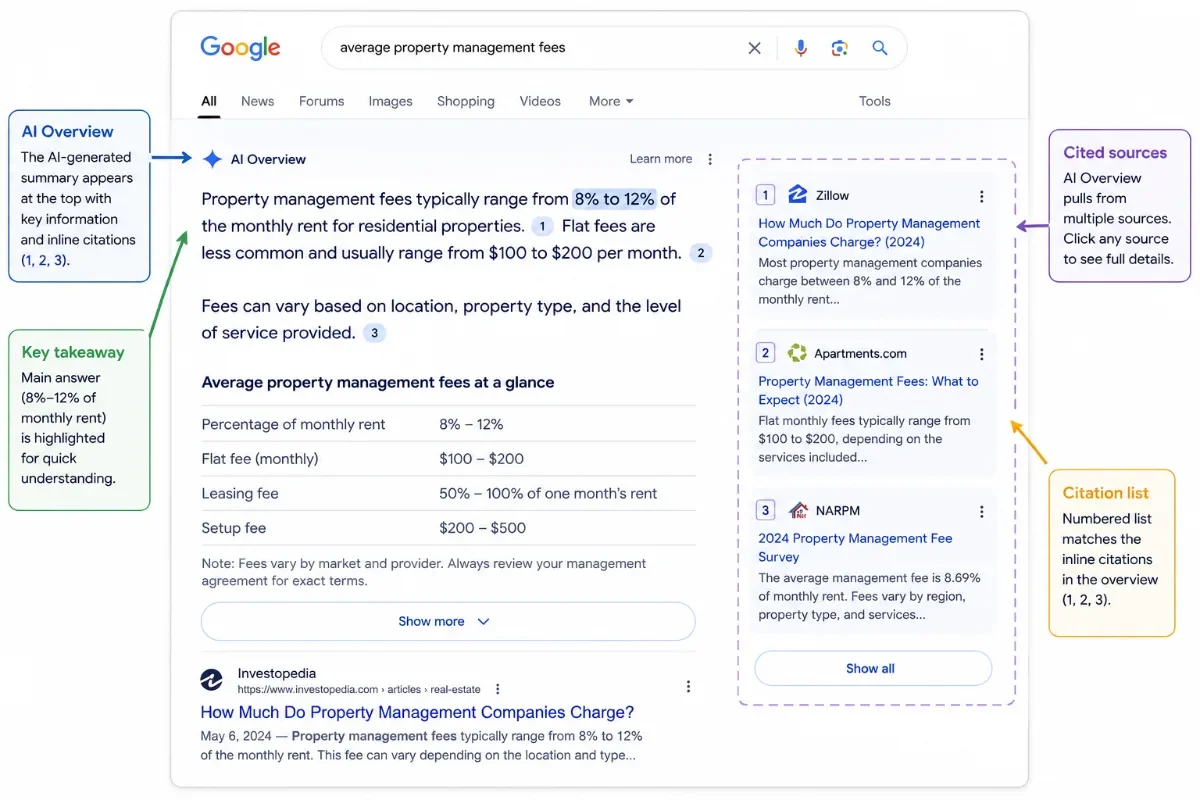
1. Cited as a source. Your page appears in the citation list of an AI Overview or ChatGPT answer ("according to clearleaddigital.com…"). Driven by content quality and extractability. This is the most achievable win and the one that drives traffic.
2. Named as a recommendation. The AI says "consider XYZ Property Management in Orlando." Driven by entity strength — reviews, local citations, directory presence, consistent NAP data, and third-party mentions. Your Google Business Profile does heavy lifting here.
3. Quoted for your data. The AI repeats a statistic or benchmark you published, sometimes without a clickable citation. This builds category authority — and AI tools remember which domains they trust on a topic.
Most PM companies chase #2 first. That's backwards. Citation (#1) is the on-ramp: AI systems recommend companies whose content they already trust.
4. Why Most Property Management Websites Are Invisible to AI
We audit PM websites every week. The same five problems make them un-citable:
No answers, only adjectives. The services page says "full-service management tailored to your needs" — and never states the fee, the response time, the markets served, or the property types managed. There is literally nothing to extract.
No question-formatted content. Owners ask AI questions. Sites with FAQ sections that mirror real owner questions ("Do you charge during vacancy?") map directly onto AI queries. Sites without them don't.
Missing or broken schema. Structured data — FAQPage, LocalBusiness, Service — is how machines confirm what a page is about. Most Squarespace and WordPress PM sites ship with none beyond the defaults.
Stale dates. AI search engines strongly prefer recently updated pages for anything involving prices or recommendations. A 2022 fee page loses to a 2026 fee page every time.
Thin entity footprint. No NARPM profile, inconsistent name/address/phone across directories, a dozen reviews. The AI can't corroborate you, so it names someone it can. Our local SEO guide for property managers covers the fix.
5. The AEO Checklist for Property Managers
Answer engine optimization (AEO) — sometimes called generative engine optimization (GEO) — is not a replacement for SEO. It's SEO with a sharper requirement: every important page must contain a direct, quotable answer.
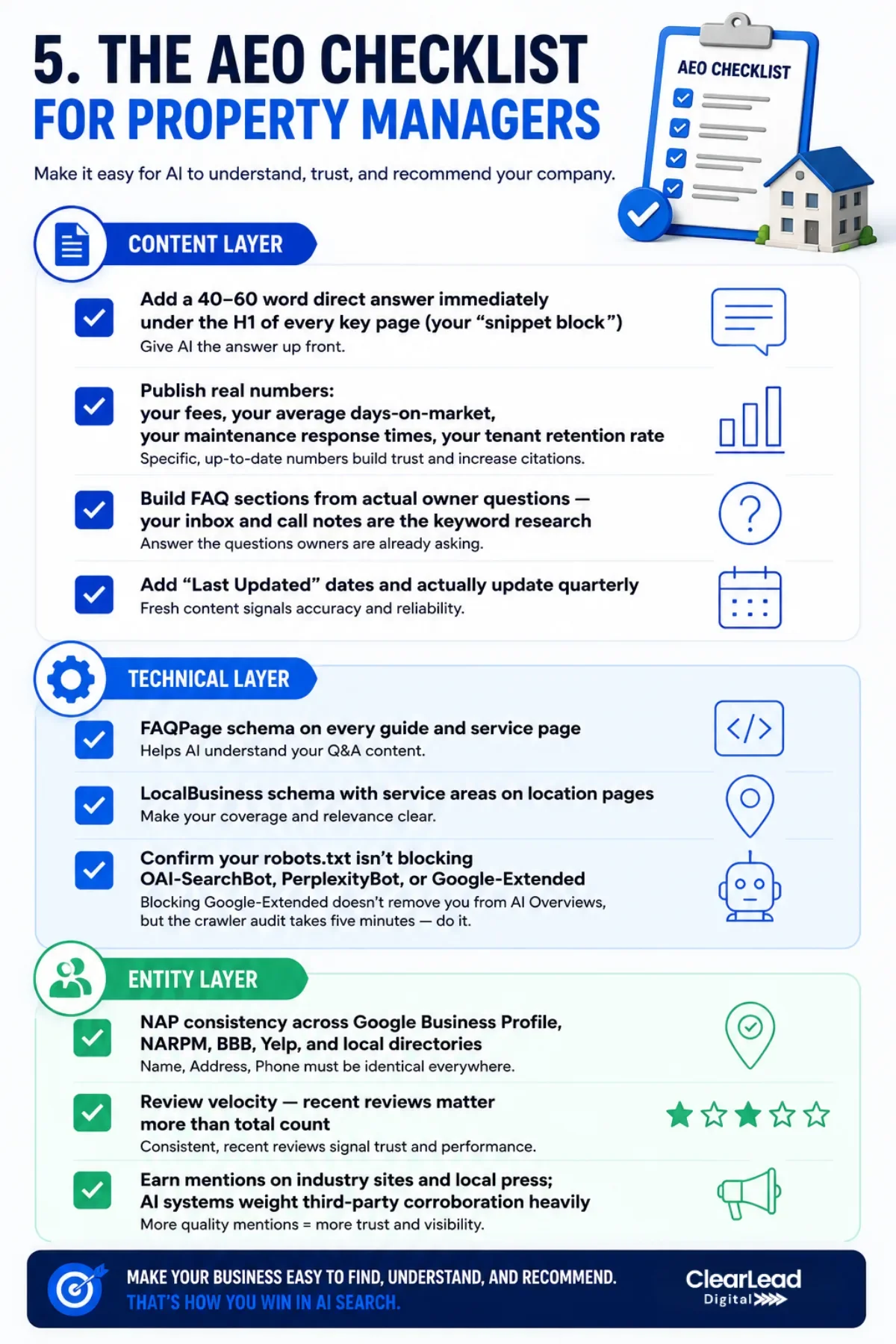
Content layer
Add a 40–60 word direct answer immediately under the H1 of every key page (your "snippet block")
Publish real numbers: your fees, your average days-on-market, your maintenance response times, your tenant retention rate
Build FAQ sections from actual owner questions — your inbox and call notes are the keyword research
Add "Last Updated" dates and actually update quarterly
Technical layer
FAQPage schema on every guide and service page
LocalBusiness schema with service areas on location pages
Confirm your robots.txt isn't blocking OAI-SearchBot, PerplexityBot, or Google-Extended (blocking Google-Extended doesn't remove you from AI Overviews, but the crawler audit takes five minutes — do it)
Entity layer
NAP consistency across Google Business Profile, NARPM, BBB, Yelp, and local directories
Review velocity — recent reviews matter more than total count
Earn mentions on industry sites and local press; AI systems weight third-party corroboration heavily
What I’ve Seen Work
The highest-leverage change is publishing your actual pricing.
Property management owners often resist this because they worry competitors will see it.
Your competitors already know your pricing. The AI answering an owner’s question does not.When an AI tool needs to explain what a company charges, it will usually favor the business that publishes clear numbers over ten companies that say “contact us for a quote.”
6. How to Test Your Own AI Visibility Today
Run this 15-minute audit monthly. We do a version of this for every client — it's the same experiment behind our AI Answers pages.
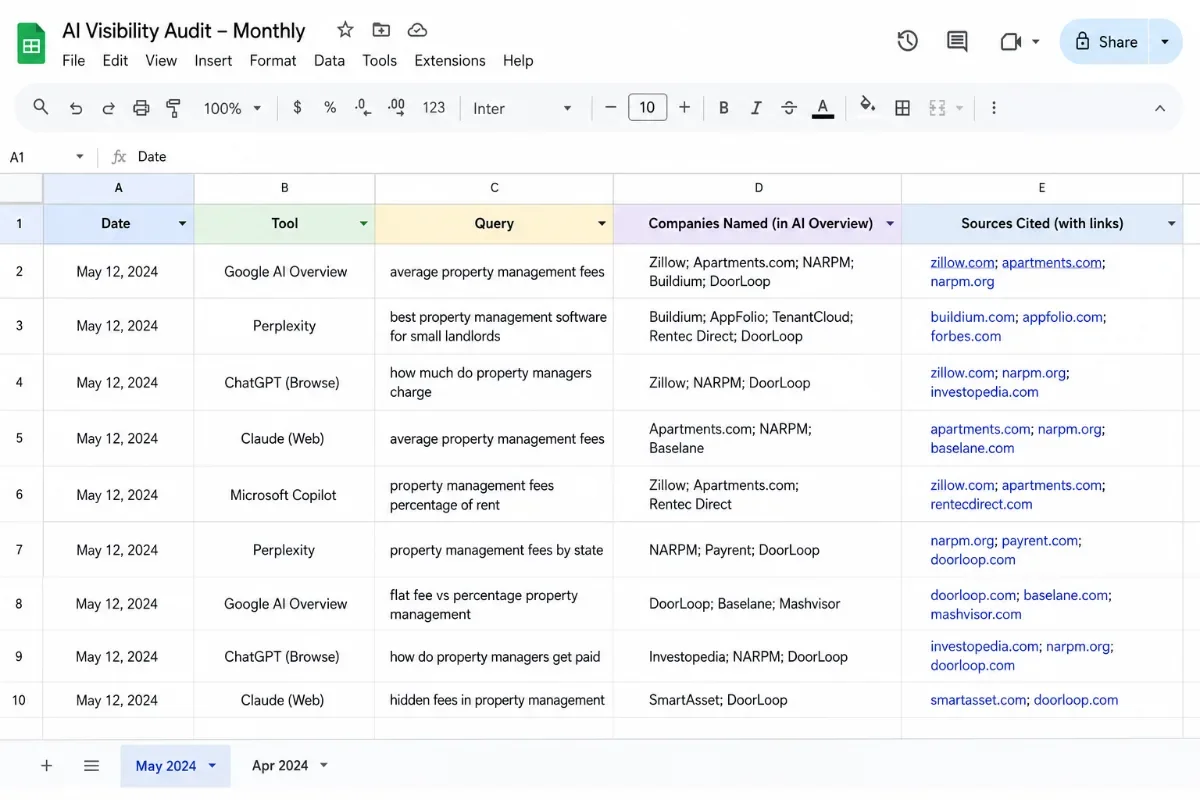
Ask ChatGPT: "Best property management companies in [your city]" and "Who should I hire to manage a single-family rental in [your city]?" Note who's named and which sources are cited.
Google an owner question you should own: "average property management fees in [your city]." Does an AI Overview appear? Whose content feeds it?
Ask Perplexity the same questions. Perplexity shows citations most transparently — it's the clearest window into which local pages are considered authoritative.
Log results in a spreadsheet: date, tool, query, companies named, sources cited. Re-run monthly.
If competitors appear and you don't, look at the cited pages. In our audits, the cited page is almost always one that states specifics — fees, comparisons, local data — in a structured format.
7. What This Means for Your SEO Budget
The uncomfortable math: AI Overviews reduce clicks on informational queries. Our own data shows pages can earn 100,000+ impressions while AI Overviews absorb a large share of would-be clicks.
The opportunity inside that math: the clicks that remain are higher intent, and AI recommendations are becoming a lead channel that compounds. An owner pre-sold by ChatGPT doesn't comparison-shop five companies — they call you.
So the budget doesn't shrink; it reallocates:
How the SEO Allocation Changes
| Old Allocation | Shift | New Allocation |
|---|---|---|
| Volume blogging for traffic | → | Fewer, deeper pages with citable data |
| Rankings as the KPI | → | Rankings + AI citations + AI-referred leads as KPIs |
| Generic service pages | → | Pages that answer specific owner questions with numbers |
| Link building alone | → | Link building + entity building through directories, reviews, and mentions |
The shift: AI search rewards useful, verifiable content — not just more content.
Property management is a local-trust business. The companies winning AI visibility in 2026 are establishing a citation moat that gets harder to displace every quarter — the same way early map-pack winners did a decade ago.
Frequently Asked Questions (FAQs)
-
Publish specific, verifiable facts about your company (fees, markets, property types, performance data) on a regularly updated website, build a consistent entity footprint across Google Business Profile and industry directories like NARPM, and earn third-party mentions. ChatGPT names companies it can corroborate across multiple sources — it cannot be paid for placement.
-
AEO is the practice of structuring your website content so AI systems — Google AI Overviews, ChatGPT, Perplexity — can extract and cite it when answering questions. For property managers, that means direct answers under headings, published pricing, FAQ schema, fresh update dates, and strong local entity signals layered on top of traditional SEO.
-
On purely informational queries, yes — many searches now end at the AI answer. But cited sources still earn clicks, and the visitors who do click through convert at higher rates because the AI answered their basic questions first. The companies hurt most are those whose content is neither cited nor clicked.
-
If you already rank in the top 10–20 for a query, formatting improvements (snippet blocks, FAQ schema, updated dates) can earn citations within weeks. Building visibility from scratch follows normal SEO timelines — typically three to six months of consistent publishing and entity building.
-
Generative engine optimization (GEO), AEO, and SEO overlap heavily — strong traditional SEO is the prerequisite. The difference is emphasis: GEO prioritizes extractable answers, verifiable statistics, structured data, and cross-web entity consistency over raw keyword targeting.
Built by Property Managers, for Property Managers
Want to Know If AI Recommends You — or Your Competitor?
We run AI visibility checks as part of every website review: which tools mention you, which sources they cite, and exactly what’s keeping you out of the answers.
See how your property management company shows up in AI search.