Apartments SEO: The Complete Strategy to Rank, Fill Units, and Cut ILS Spend
⏱ 8 Minute Read
Last Updated: August 3, 2026
Apartment SEO is how multifamily operators turn their own website into a lead-generating asset instead of relying on expensive listing services. This guide walks through every step of a modern apartments SEO strategy—from auditing your site to preparing for AI search—so you can hand it to your marketing team or agency partner and start executing.
Table of Contents
- What Is Apartment SEO and Why It Matters in 2026
- How Apartment SEO Reduces ILS Dependence and Paid Ad Costs
- Understanding Your Two Core Audiences
- Conducting an Apartment SEO Audit
- Keyword Strategy for Apartments
- On-Page SEO for Apartment Websites
- Local SEO Essentials
- Content Marketing That Attracts and Converts
- Reputation Management and Reviews
- Technical SEO and Schema Markup
- Measuring Performance
- Future of Apartment SEO: AI Search and 2026+
- Bringing It All Together
- Frequently Asked Questions (FAQ)
What Is Apartment SEO and Why It Matters in 2026
Apartment SEO is the practice of optimizing multifamily websites and community websites so they appear prominently in every major search engine—Google, Bing, and emerging AI search platforms—when prospective residents type renter-intent or owner-intent queries. It covers technical SEO, on-page SEO, content marketing, and local SEO, all tailored to the unique needs of apartment communities and property management companies.
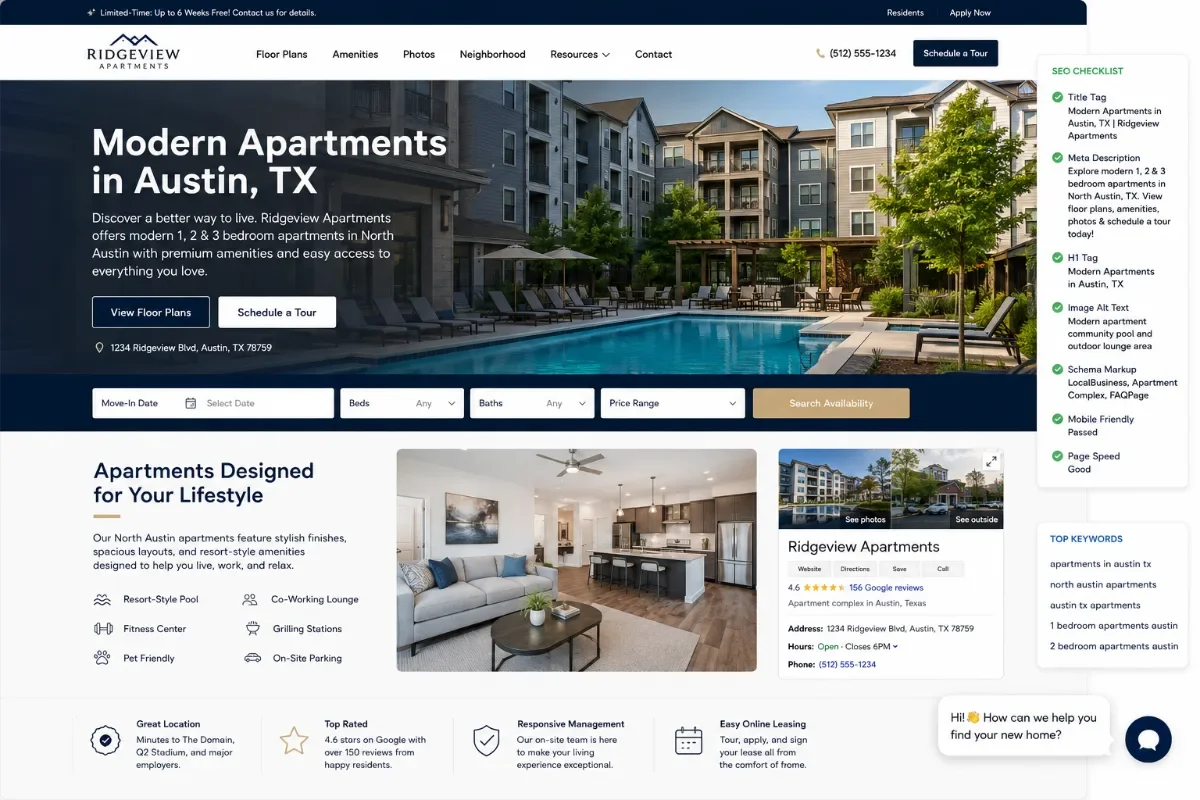
The 2026 Renter Reality: Over 81% of recent renters used a mobile website during their search, and 87% started with generic queries (budget, neighborhood, amenities) rather than a specific community name.
Renters search broadly, research roughly ten properties, and narrow to two or three serious contenders before reaching out. If your apartment website isn't visible in organic search results for the phrases renters actually type, you're invisible during the decision window that matters most.
- Community-level SEO: Focuses on filling units and reducing dependence on Internet Listing Services (ILS).
- Property management SEO: Targets owner and investor leads to grow doors under management.
Both require different keyword research, content, and conversion paths. The business outcomes are tangible: more qualified leads, lower cost per lease, and reduced ILS ad spend. At ClearLead Digital, we design SEO strategy specifically for apartment communities and property managers.
How Apartment SEO Reduces ILS Dependence and Paid Ad Costs
Large ILSs like Zillow, Apartments.com, and Rent.com dominate generic phrases such as "apartments in Phoenix AZ" through massive domain authority and ad budgets. You cannot outspend them in paid advertising or backlink acquisition. But you can beat them where they're weakest: localized organic search results and the Google Map Pack.
Communities with strong local SEO signals consistently appear in the three-pack for queries ILSs struggle to own. Here is how the economics shift:
- Organic search results carry a 39% click-through rate, far higher than most paid media channels.
- Organic traffic compounds—every technical fix, content piece, and review you earn keeps working long after you publish.
- In one documented case, REACH SEO generated 144% more leases than ILSs over a three-month period, despite the ILS campaign spending over $1.1 million.
Scenario: A Phoenix community investing in organic SEO and local discovery improvements could cut ILS spend by 25% to 40% over twelve months as organic search traffic grows 150% to 200%.
The difference is ownership. SEO builds brand authority on your own website, whereas paid search and third-party leads are rented traffic on someone else's platform.
Understanding Your Two Core Audiences
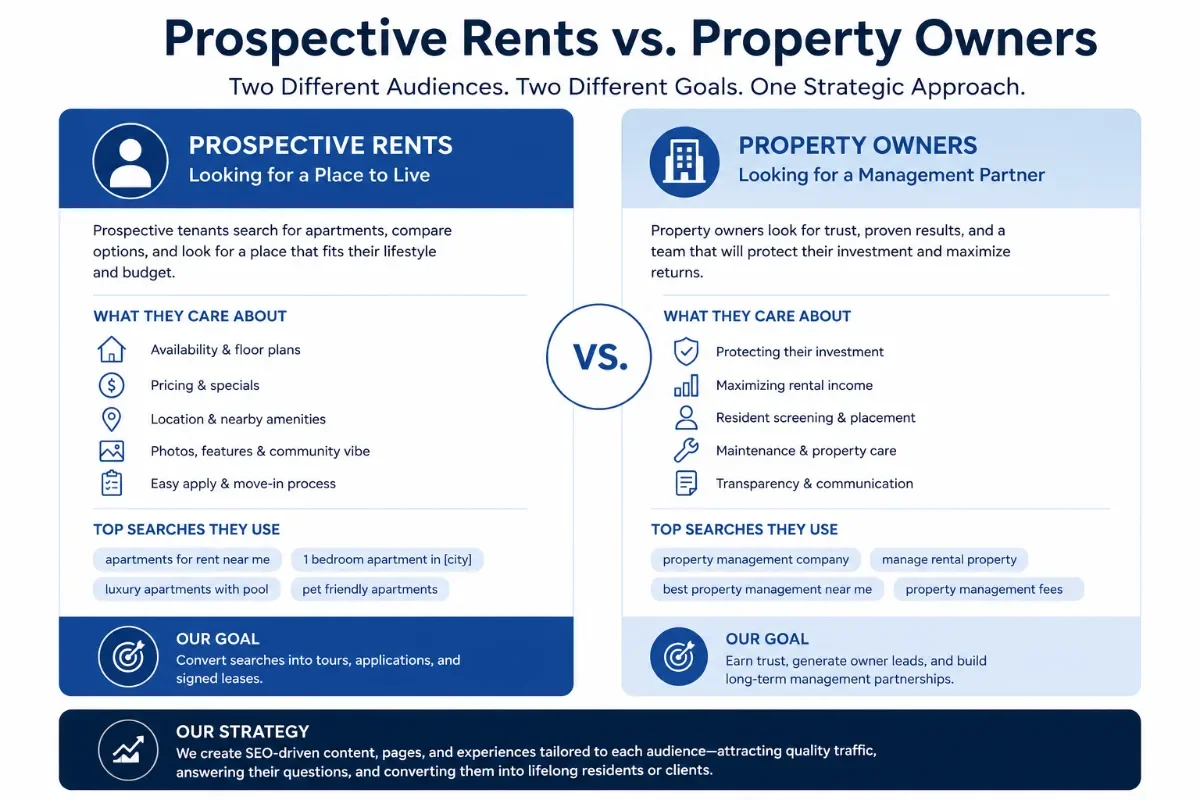
An effective apartments SEO strategy must speak to two distinct audiences with separate search intents and conversion paths. Mixing both audiences on the same pages dilutes search relevance and hurts conversions.
| Target Audience | Search Intent & Focus | Example Keyword Queries | Target Conversion Path |
|---|---|---|---|
| Prospective Renters | Immediate housing needs, availability, budget, lifestyle, and amenities. | "1 bedroom apartments in Denver under $1,800", "pet friendly apartments near Sloan's Lake" | Schedule a Tour, View Floor Plans |
| Property Owners & Investors | Business evaluation, management services, lease-up expertise, and fees. | "Denver property management company for 50+ unit buildings", "Property management fees in Phoenix" | Request a Proposal, View Portfolio Case Studies |
ClearLead Digital structures site architecture so renter-facing pages and owner-facing pages each target distinct long-tail keywords.
Conducting an Apartment SEO Audit
Any serious SEO strategy for 2026 begins with a structured audit. Here is what to check across three critical layers:
| Audit Category | Key Elements to Check |
|---|---|
| Technical SEO |
HTTPS: Security across every page. Core Web Vitals: Mobile scores for loading, interactivity, and visual stability. Crawl Errors: Broken links and 404s. XML Sitemap: Submitted properly for discovery. Site Speed & Mobile: Compressed images, limited heavy vendor scripts, mobile-first design. |
| Content & On-Page |
Thin Content: Duplicated floor plan pages with minimal unique copy. Meta Data: Missing or generic meta descriptions and page titles. Heading Structure: Weak H1/H2 hierarchy. Gaps: Lack of renter-focused FAQs or neighborhood content. |
| Local SEO |
NAP Consistency: Name, Address, Phone matches across the web. Schema Markup: Missing tags ( ApartmentComplex, LocalBusiness, Review).Google Business Profile: Incomplete categories, missing photos. Citations: Duplicate or outdated directory listings. |
Pro Tip: ClearLead Digital typically performs this audit in the first 30 days of engagement and prioritizes fixes that move search rankings and conversions fastest.
Keyword Strategy for Apartments
Keyword research guides every other SEO decision. Think in three tiers:
- Broad city phrases: "apartments in Austin TX". High volume, high competition, dominated by ILSs.
- Mid-intent modifiers: "2 bedroom apartments in Austin near UT campus". More specific, less competition.
- Long-tail keywords: "South Lamar Austin apartments with pool and in-unit washer dryer". Lower competition and higher conversion rates.
Mapping Keywords to Pages:
- Community homepage: "apartments in [city]" + neighborhood variants
- Floor plan pages: "2 bedroom apartments [neighborhood]" + amenity modifiers
- Amenity pages: "apartments with gym in [city]", "pet friendly apartments [city]"
- Blog posts: neighborhood guides, comparison pages, FAQs
- Owner service pages: "[City] multifamily property management company"
On-Page SEO for Apartment Websites
On-page SEO is where search rankings and user experience meet.
- Title tags: Combine primary keyword, neighborhood, and brand (e.g., "Pet-Friendly Apartments in Tempe AZ | Riverstone Flats"). Keep within 50 to 60 characters.
- Meta descriptions: Treat them as ad copy. Highlight price range, a standout amenity, and a call to action.
- Heading structure: Use one clear H1 reflecting the primary keyword. Use H2s for amenities, floor plans, location details, and FAQs.
- Renter-centric content: Specify pet policies, parking options, utility inclusions, lease terms, and tour availability.
- Internal linking: Link from high-traffic pages to conversion pages like "Schedule a Tour" or "Apply Now." Cross-link amenity pages to neighborhood guides.
Local SEO Essentials
For apartment communities, local SEO is often the highest-converting part of the entire strategy. A well-optimized Google Business Profile (GBP) can generate massive lease volume.
Optimize your GBP fully:
- Set the correct primary category ("Apartment Complex" or "Property Management Company").
- Write a compelling description with local keywords and amenities.
- Add UTM-tagged website and appointment links for tracking.
- Upload high-quality photos of interiors, exteriors, amenities, and the neighborhood.
- Post updates regularly and fill out the Q&A section with common renter questions.
Citation Warning: Accurate NAP (Name, Address, Phone) consistency is critical. Even small variations ("St" versus "Street") can confuse search engines.
Content Marketing That Attracts and Converts
Content marketing for apartments goes beyond basic floor plan descriptions. It builds topical authority and answers the nuanced questions renters now ask traditional search engines and AI tools.
High-value content types to prioritize:
- Neighborhood guides: "Living in Capitol Hill Denver: A 2026 Guide for Renters."
- Amenity deep dives: Pet policies, parking breakdowns, virtual tour guides.
- Comparison pages: "Downtown vs Midtown Phoenix Apartments: Pros and Cons."
- FAQ content: "Are pit bulls allowed?", "Are utilities included?", "How do I apply?"
Reputation Management and Reviews
Online reviews directly influence local search rankings and strongly affect whether renters click through from search engine results.
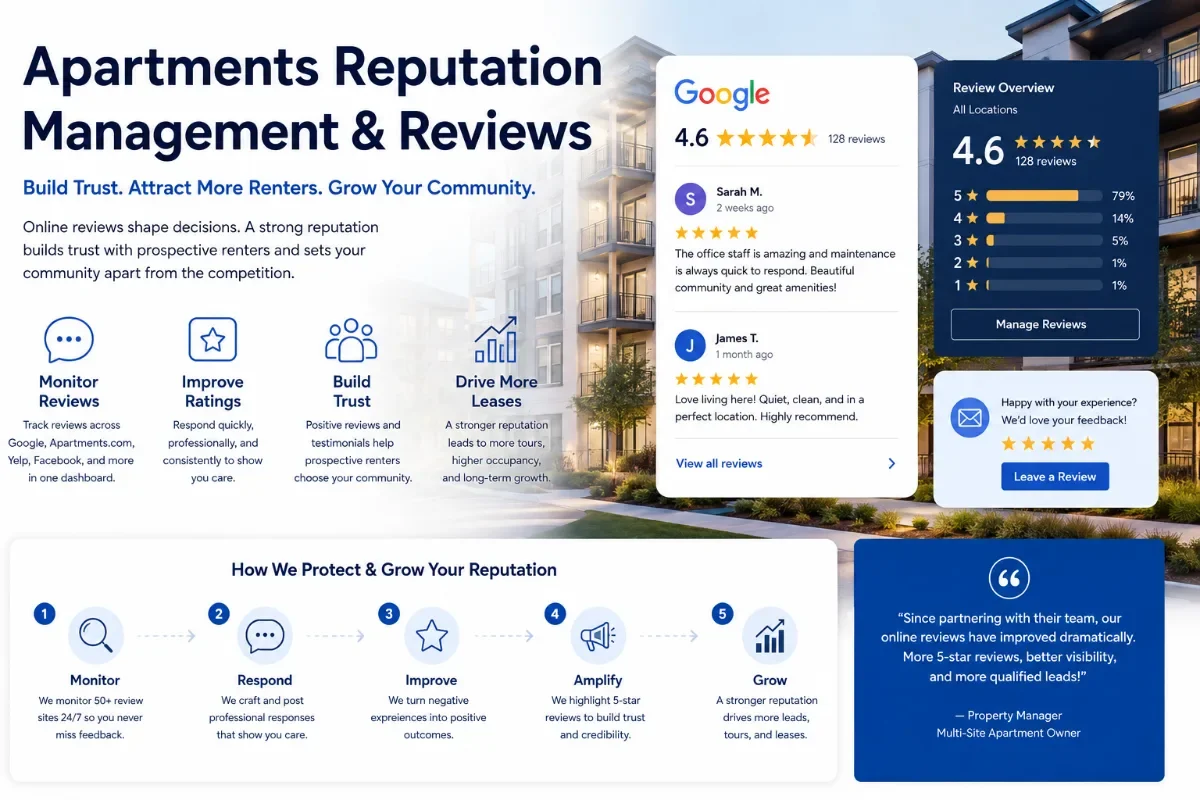
A simple review generation system:
- Send automated post-move-in emails or SMS with a direct link to your GBP review page.
- Follow up after positive maintenance interactions.
- Include QR codes in welcome packets pointing to your review form.
Respond to all reviews professionally to build trust and signal active management.
Technical SEO and Schema Markup
Technical SEO ensures search engines can efficiently crawl, understand, and trust your apartment website.
Technical priorities for multifamily websites:
- Compress images and use lazy loading for photo galleries and virtual tours.
- Minimize JavaScript bloat from chat widgets and ILS feeds that tank mobile performance.
- Maintain clean URL structures.
- Configure 301 redirects when removing or renaming floor plan pages.
Schema markup for apartments:
ApartmentComplexandLocalBusinesson community pages.FAQPageon pet policy, parking, and application FAQ pages.Reviewschema to surface star ratings in search results.
Measuring Performance
Tracking performance metrics is essential for effective SEO—without measurement, you're guessing.
| Tool | What to Track |
|---|---|
| Google Analytics 4 (GA4) | Engagement metrics, goal completions (tour requests, applications, click-to-call). |
| Google Search Console | Search queries, impressions, click-through rates, indexing status. |
| GBP Insights | Local actions including calls, direction requests, and website visits. |
Tag conversion buttons as GA4 custom events, use call tracking for organic phone leads, and segment owner versus renter leads.
Future of Apartment SEO: AI Search and 2026+
AI-driven search experiences (Google AI Overviews, Bing Copilot, ChatGPT, Perplexity) increasingly provide direct answers to renters' questions instead of just blue links.
According to Apartments.com research, 77% of people using Google AI Overviews say they make decisions more quickly, and 75% more confidently.
What this means practically:
- FAQ schema, review schema, and structured data become even more critical.
- Voice and natural-language queries need to be reflected in your content and keyword planning.
- Core SEO fundamentals—fast sites, trustworthy content, local SEO—still power search visibility in generative engines.
Bringing It All Together
The system is straightforward: conduct a structured audit, build a keyword plan, fix technical SEO, optimize on-page elements, strengthen local SEO, invest in content marketing, and manage your online reputation.
What to expect:
- Meaningful organic search improvements within 3 to 6 months.
- Dramatic reductions in ILS and paid ads dependence over 9 to 12 months.
- Proven strategies that compound over time.
Ready to see where your communities stand? Run a self-audit using the checklists in this guide, benchmark your current GA4 traffic, and evaluate partnering with a B2B multifamily specialist like ClearLead Digital.
Frequently Asked Questions (FAQ)
What is the difference between Community SEO and Property Management SEO?
Community SEO is designed to attract prospective renters to fill vacant units by targeting location and amenity-based keywords. Property Management SEO targets property owners and real estate investors looking for management services, using B2B-focused keywords and conversion paths.
How long does it take for Apartment SEO to show results?
You can typically expect to see meaningful organic search improvements and traffic increases within 3 to 6 months. More significant impacts, such as a noticeable reduction in ILS dependence and lower paid ad costs, generally compound over 9 to 12 months.
Why is my apartment community not showing up in the Google Map Pack?
Map Pack visibility relies heavily on Local SEO signals. Common reasons for not appearing include an unoptimized or unverified Google Business Profile, inconsistent NAP (Name, Address, Phone) information across the web, a lack of recent positive reviews, or missing local keywords on your community website.
Do I still need Internet Listing Services (ILS) if I invest in SEO?
While you may not eliminate ILS completely right away, a strong SEO strategy will significantly reduce your dependence on them. Many of our clients are able to systematically scale down their ILS spend and shift their budgets as organic search begins consistently delivering qualified tour requests and applications.