SEO Agent: How AI Agents Are Rewiring Modern SEO (From Research to Rankings)
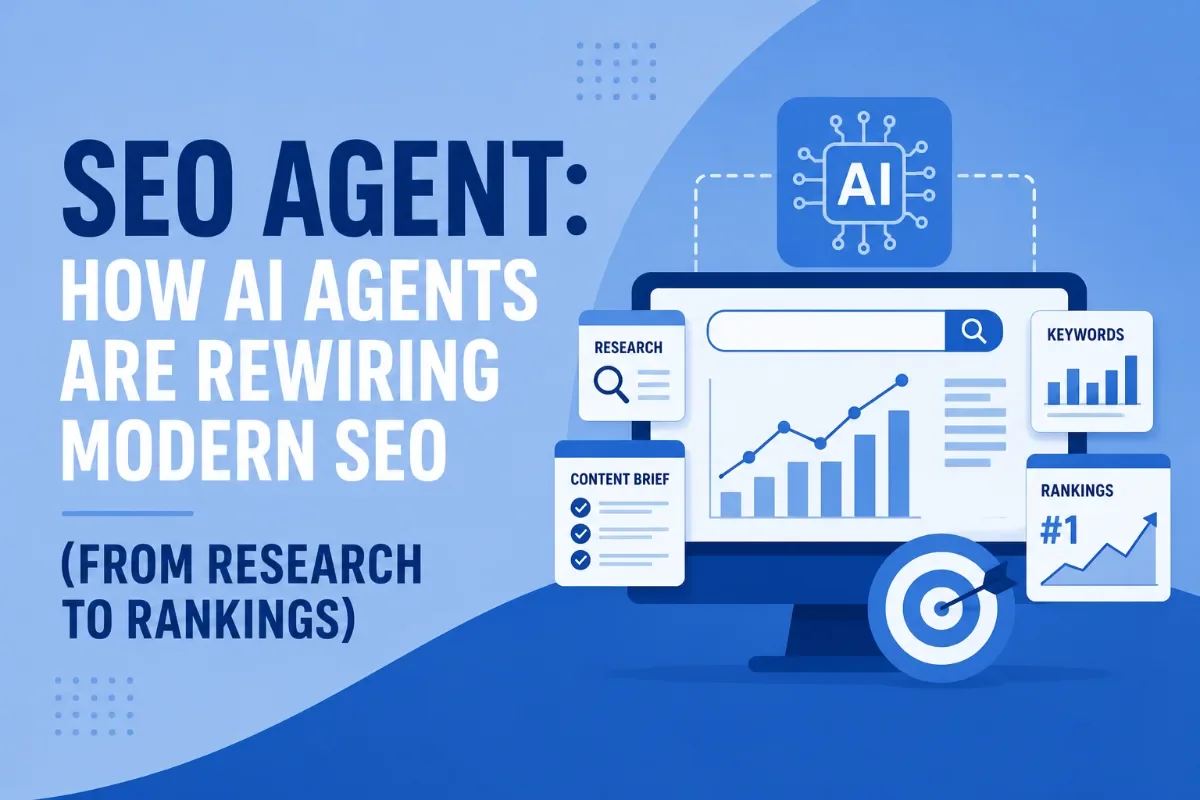
SEO has always been a game of compounding actions: research, optimize, publish, monitor, repeat. The problem is that most SEO teams spend the bulk of their time on repetitive execution rather than strategy. Enter the SEO agent — an AI-powered system that doesn't just suggest what to do, but actually does it. This guide breaks down how AI SEO agents work, what they can handle today, and how to start using them without losing control of your SEO strategy.
In this guide
- What is an SEO agent?
- How they work under the hood
- Why agents beat manual SEO
- Core capabilities
- Keyword research & intent
- Building topical authority
- Content optimization
- Technical SEO automation
- Internal linking at scale
- Backlink prospecting
- Monitoring & decay
- Your first workflow
- Skills vs agents
- Connecting to real data
- Off-the-shelf vs custom
- Governance & QA
- Realistic outcomes
- Getting started
What is an SEO agent (and why it matters in 2025–2026)?
An SEO agent is an autonomous or semi-autonomous AI agent that executes SEO workflows end-to-end. Rather than generating a list of keywords and leaving you to figure out the rest, an SEO AI agent takes a goal — like increasing organic traffic on product pages — breaks it into sub-tasks, fetches live SEO data, acts on findings, evaluates results, stores what it learned, and moves to the next step.
This is a fundamentally different animal from a classic AI SEO tool:
- A traditional AI SEO tool does one job: generate keywords, check meta tags, or audit crawl errors. An SEO agent chains those tasks together into a coordinated workflow, adapting as it goes.
- SEO agents connect to real data through APIs — Google Search Console, Google Analytics, Ahrefs, Semrush — to pull fresh metrics like rankings, CTR, crawl errors, and keyword volumes. Decisions are data-dependent, not based on static snapshots.
- An SEO agent improves visibility and rankings by continuously acting on what the data reveals, not waiting for a quarterly review.
- The context has shifted: AI Overviews and answer engines like ChatGPT, Perplexity, and Gemini now surface content directly. 38% of AI Overview citations come from top-10 Google results — brands need content that both ranks traditionally and gets cited by AI.
- The terms GEO (Generative Engine Optimization) and AEO (Answer Engine Optimization) describe this dual mandate. Agents help you optimize for both surfaces simultaneously.
- In 2025–2026, search engines and AI systems evaluate not just keyword presence, but content structure, intent alignment, freshness, and entity clarity — all areas where agents operate.
How SEO AI agents work under the hood
Understanding the architecture helps you evaluate what's real versus marketing fluff. AI SEO agents autonomously execute multi-step tasks by combining a few core components into a single system.
- LLM brain: a large language model (Claude, GPT-4.x, Gemini, or fine-tuned variants) drives reasoning, planning, drafting, and evaluation.
- Tool/API layer: connections to Search Console, analytics platforms, crawl tools, CMS REST APIs, and SEO tools like Ahrefs or Semrush — how the agent pulls and pushes real-time data.
- Memory/state layer: internal storage (often vector databases or structured memory files) holding past actions, performance thresholds, and learnings. This is what separates an agent from a one-shot prompt.
- Instructions & skill files: documented workflows that tell the agent how to break goals into steps, what policies to follow, when to require human approval, and how to handle edge cases.
Here's the typical pipeline an agent follows:
- Goal definition — user sets a target ("refresh the AI Agents content cluster").
- Research — keyword discovery, competitor research, SERP analysis, search-intent inference.
- Audit — technical audit (crawl errors, speed), content audit (decay, weak pages), gap analysis.
- Planning — content briefs, topic-cluster maps, metadata changes, schema recommendations.
- Execution — draft content, optimize existing content, fix technical issues, add internal linking.
- Monitoring — pull analytics and Search Console data; detect drops; measure impact.
- Adjustment — write learnings to memory; refine thresholds; cycle again.
An agent receives a new product-page URL. It first runs a technical audit — broken links, page speed, duplicate meta tags, canonical correctness. Then it fetches the top-10 SERP for the target keyword to analyze content types, and identifies that the page uses how-to content while the SERP shows transactional intent (comparisons, feature lists). It suggests restructuring the page, adds product schema, and recommends internal links from related blog posts. After human review, changes go live — and the agent monitors CTR and rankings for the next 4–6 weeks.
Why SEO agents beat manual SEO for repetitive work
The typical manual workflow involves an analyst doing keyword research, a writer creating content, a developer implementing technical fixes, and a PM coordinating everyone. An SEO AI agent handles large parts of this with a fraction of the overhead.
- Time compression: weeks of manual keyword research and clustering collapse into minutes. One agency reported 5,220 task-runs in 4 months at a 98% success rate — over 40 tasks per day.
- Consistency: agents don't forget canonical tags, miss broken redirects, or skip schema validation. Every page gets the same checks, every time.
- Reporting speed: teams report saving 20–40 hours per month on reporting and audits alone.
- Faster decay response: agents flag decaying pages within days of the decline starting, not at a quarterly review.
- Competitor depth: an agent runs competitor analysis on a continuous loop, surfacing changes you'd otherwise miss.
- Scalability: adding 50 new pages to monitor is a configuration change, not a hiring decision.
The work agents relieve — rank tracking, site audits, content-decay detection, internal-link suggestions, outreach prep — is precisely the work that eats an SEO expert's time without requiring creative judgment.
Core capabilities of modern SEO agents
Think of this as the capability map of what a good SEO agent can handle day-to-day.
- Keyword research & clustering: pull seed keywords, expand via APIs, filter by volume and difficulty, and cluster by topic and intent — chaining methods together and reusing memory across sessions.
- Content optimization: analyze competitor structure, headings, entities, readability, and schema, then rewrite or augment content.
- Technical SEO: detect crawl errors, duplicate titles, and slow pages, and prioritize fixes by traffic potential — acting, not just reporting.
- Internal linking: scan your full content library and suggest contextual links while maintaining anchor diversity.
- Backlink prospecting & outreach: identify relevant prospects, draft personalized emails, and track placement progress.
- SERP monitoring & intent analysis: watch for ranking shifts, SERP-feature changes, and competitor movements.
- Reporting & performance monitoring: pull from multiple sources, generate dashboards, and flag anomalies.
- Real-time data analysis: operate on fresh signals and adapt within the same workflow cycle.
Most teams start with one or two of these and expand into a full workflow over time as trust and infrastructure mature.
Keyword research & search-intent clustering
Keyword research is one of the highest-volume SEO workflows in any team — and it's structured, repetitive, and data-driven, which makes it the first big win for AI SEO agents.
- Seed collection: the agent pulls seed terms from your positioning, existing content, or brand terms.
- Expansion: using API access to Ahrefs, Semrush, or DataForSEO, it expands seeds into hundreds of related keywords, questions, and long-tail variations.
- Filtering: it removes irrelevant terms, filters by volume and difficulty relative to your domain authority, and discards keywords outside your realistic ranking range.
- Clustering: it groups keywords by intent — informational, transactional, commercial, navigational — replacing spreadsheet-heavy manual work.
- SERP intent verification: for each cluster, the agent fetches the top-10 results to confirm real intent. If your target keyword shows comparison pages in positions 1–5, a how-to blog post won't rank.
A B2B SaaS company in workflow automation asks the agent to research "workflow automation." It clusters results into: A — automation software reviews & features (commercial); B — use-cases & best practices (informational); C — comparison pages, "workflow automation vs process automation" (comparison); D — buying guides & pricing (transactional). The outcome: a prioritized keyword list plus 3–5 content-cluster ideas that feed directly into planning — in minutes, not days.
Building topical authority with AI-driven content clusters
Topical authority — how comprehensively your site covers a topic — matters more than ever. Post-2024, Google's Helpful Content evolution and AI Overviews both favor sites that demonstrate deep, structured expertise over scattered, shallow coverage.
- Agents group keywords into clusters around themes, then map pillar pages and supporting articles so the full breadth of a topic is covered.
- Example: an "SEO AI Agent" hub with pillars like "AI SEO tool comparison," "building SEO AI agents from scratch," "agent workflows for agencies," and "technical SEO automation," with supporting articles filling gaps.
- The agent recommends internal links within each cluster to strengthen topical relevance and crawl paths.
- The result: better rankings across a whole topic, not just isolated keywords — and higher chances of being cited in AI answers, where systems look for comprehensive, interlinked sources.
- Over time, this helps you own territory in your niche rather than competing page-by-page.
Content optimization: from draft to AI-ready SEO asset
Content optimization is the highest-leverage use case because small improvements cascade across rankings, traffic, and conversions.
- Audit the existing content: the agent analyzes word count, structure, entities, headings, schema, and links, checking quality against top-ranking competitor pages.
- Align with search intent: if a transactional keyword is answered with a pure informational post, the agent flags the mismatch and proposes restructuring — perhaps into a comparison page or feature breakdown.
- Optimize for AI engines: ensure content has concise definitions, clear entity mentions, cited sources with dates, FAQs, and structured data. This dual optimization matters — optimized content can drive a 42% higher conversion rate from AI-referred traffic.
- Concrete deliverables: a prioritized list of 3–5 updates per page — e.g., "Add 2025 statistics to Section 3," "Add FAQ about agent pricing," "Update meta description with an action verb," "Include product schema," "Add internal links to three supporting pillars," "Restructure H2s to match the top-3 SERP outline."
Technical SEO automation with AI agents
Technical SEO is pattern-heavy, rule-based, and ideal for automation.
- Crawl & data collection: the agent runs or accesses site crawls via API, handling sitemaps, thousands of URLs, and edge cases like JavaScript-rendered pages.
- Detection & prioritization: it identifies 4xx/5xx errors, duplicate titles, missing alt text, slow pages, and mobile issues, then prioritizes by traffic potential and severity.
- Templated fixes: schema markup and meta-tag optimization are exactly the kind of fixes agents handle well.
- Advanced behavior: for low-risk fixes, the agent drafts changes directly; for higher-risk changes (site-wide template edits, canonical restructuring), it creates tickets in Jira or Linear for dev review.
- Continuous monitoring: it reruns audits weekly, verifies previous fixes took hold, and updates a technical health score — turning a quarterly project into a continuous process.
After a CMS migration in June 2025, an agent detects 150 new 404 errors. It groups them by URL pattern, drafts a redirect map, generates a CSV for implementation, and opens pull requests for meta-tag and canonical corrections.
Internal linking at scale using SEO agents
Internal linking is high-impact but most teams neglect it because it's tedious across hundreds of pages.
- The agent scans your full content library — published and draft — identifying relevant anchor phrases and topically related pages.
- For a new article, it identifies existing content that should link to it and suggests placement.
- For existing content, it surfaces structural patterns in your link graph and recommends new connections between supporting articles and pillars.
- Example: launching a new "AI SEO tool" guide, the agent recommends 20 contextual links from older posts on keyword research, content optimization, and agent workflows.
- Agents avoid spammy patterns by diversifying anchor text, limiting links per page, and respecting UX (no walls of links above the fold).
- For implementation, the agent produces a CSV or CMS-ready changeset — or pushes changes directly via API if your stack allows.
Backlink prospecting & outreach with AI agents
Link building remains one of the most time-intensive parts of SEO. Agents automate prospecting and outreach, cutting the manual effort dramatically.
- Given a target URL and keywords, the agent finds relevant prospects — blogs, directories, resource pages — and scores them by domain authority, topical fit, recency, and existing mentions.
- It drafts personalized outreach emails referencing the prospect's latest article or a relevant section.
- It handles follow-ups automatically, tracking responses and placements and updating a shared sheet or CRM.
- It tracks placement quality after publication, checking that links remain live and the linking page keeps its authority.
- Campaigns run in the background, freeing your team for relationship-building and strategy rather than spreadsheet management.
Monitoring rankings, content decay & performance
Ongoing monitoring is the "eyes and ears" of an SEO agent. SEO is not set-and-forget, and agents keep watch around the clock.
- Performance monitoring: the agent pulls daily or weekly data from Search Console and GA4 — clicks, CTR, impressions, conversion rate for every target page — and flags anomalies the moment they appear.
- Content-decay detection: it flags URLs where impressions or clicks dropped 20–30% over the last 3–6 months.
- Example: a post from March 2023 loses visibility in early 2025. The agent flags it and recommends updating statistics, adding FAQs, filling content gaps found via competitor research, and re-optimizing headings to current SERP patterns.
- Competitor monitoring: weekly briefings surface new pages, ranking shifts, and backlink gains.
- Reporting: auto-updating dashboards and monthly/quarterly decks summarizing wins, losses, and recommended actions — helping identify which strategies work and which to adjust or abandon.
Designing your first SEO agent workflow
If you're new to this, start with one clear, high-ROI workflow before automating everything.
- Pick the workflow: something repetitive and well-defined — content refresh, keyword research, or reporting.
- Document the current process: write down exactly what you do manually today — inputs, outputs, who's involved.
- Define success metrics: time saved, pages refreshed, ranking improvements, reduction in crawl errors — something measurable.
- Translate into agent steps: map each manual step to a task, and ensure you have the data sources and API access needed.
- Prototype small: use cheaper models for initial testing; refine prompts and skill files before scaling.
- Build in human-review gates: especially for content that goes live or changes that affect many pages.
A "content refresher" agent takes a URL, pulls 12 months of Search Console data, compares the page's content and headings against the top-3 SERP competitors, and outputs a refresh brief — new sections, updated stats, added FAQs, and internal-link opportunities. An editor reviews and approves before anything publishes.
From skills to full SEO AI agents
Understanding the difference between "skills" and "agents" helps you build systems that scale.
- Skills are narrow, documented instructions for a single task: keyword discovery, on-page audit, internal-link suggestion, meta-description rewrite. Each skill file includes instructions, example inputs/outputs, and edge-case handling.
- An SEO AI agent is the container that uses many skills and tools to reach a goal, dynamically choosing which skill to apply based on the request, available data, and memory from past runs.
- Document each key task as a separate skill file — a modular approach that lets you test, improve, and swap skills independently.
- Define trigger phrases or events: "new blog-post outline," "update this page for new search intent," "find internal links for this article."
- Over time, the agent builds memory about your site — which formats perform best, which difficulty thresholds are realistic, which competitor patterns to surface.
Connecting SEO agents to real data & your stack
Reliable agents must connect to real, verified data sources — not rely on guesses. Without live data, an agent is just a chat interface generating plausible-sounding recommendations with no grounding.
- Typical integrations: Google Search Console (impressions, CTR, queries), GA4 (traffic, engagement, conversions), Ahrefs/Semrush (volumes, backlinks, content gaps), CMS platforms (WordPress, Webflow, Shopify), and Slack/email.
- The Model Context Protocol (MCP) from Anthropic is becoming a standard for exposing data sources and CMS actions to agents in a structured, secure way.
- Concrete data flow: the agent reads Search Console for /blog/ pages, finds URLs with declining CTR, fetches top-3 SERP competitors to find missing entities, generates updated titles and descriptions, creates a CMS draft, alerts an editor, and — on approval — publishes, then monitors impact.
- Security: use least-privilege API access (read-only where possible, write only where needed), maintain audit trails of every action, and ensure rollback capability for anything pushed to production.
Off-the-shelf SEO AI agents vs custom builds
The "buy vs build" decision depends on your team's resources, workflow complexity, and risk tolerance.
Off-the-shelf pros
- Faster to deploy; usable out of the box.
- Predictable pricing and vendor support.
- Pre-built integrations with common tools.
- Opinionated workflows that enforce best practices.
Custom build pros
- Tailored to your content types, CMS, brand voice, and niche thresholds.
- Full control over prompts, logic, approval gating, and governance.
- Can integrate proprietary data and domain knowledge.
- Grows with your process, not someone else's roadmap.
In-house teams with dev resources often lean toward custom builds for critical workflows; agencies managing many clients may prefer off-the-shelf tools to scale quickly; enterprise sites with sensitive brand voice often run a hybrid. Start with one or two prebuilt agents, then layer in custom agents where control matters most.
Implementing SEO agents safely: governance & quality control
Automation without guardrails can harm content quality or technical health. The more capable your agents, the more important governance gets.
- Human-in-the-loop approvals: require sign-off for publishing content, editing templates, or updating large page groups. No agent should have unreviewed write access to production.
- Content quality gates: check tone, factual accuracy (sources dated 2024–2026), grammar, and brand-voice alignment. Draft-generating agents should always require editor approval.
- Technical quality gates: validate that changes don't introduce broken links, invalid schema, canonical errors, or mobile regressions.
- Logging & audit trails: log every action — what changed, when, which skill triggered it, what data drove the decision — with the ability to roll back.
- Policy documentation: write down thresholds (what counts as "content decay," which difficulty cut-offs), parameters, and edge cases. This separates a reliable agent from a loose cannon.
Realistic outcomes you can expect
Set expectations early: agents dramatically cut time on repetitive tasks but don't replace strategic thinking. Agents are the execution layer, not the strategy layer.
- Time savings: 20–60% reduction in hours on research, reporting, and audits. Content output can increase 2–4× with similar or better quality.
- Traffic & rankings: results compound over 6–12 months through clustered publishing, continuous refresh, and technical fixes.
- Conversions: when content is optimized for both search and AI citation, conversion from organic and AI-referred channels improves meaningfully.
- Soft wins: fewer context-switches, clearer documentation, and better cross-team collaboration.
- Limitations: agents may hallucinate, misinterpret data, or apply rules too aggressively. Initial ROI may be modest until memory and thresholds mature. Strategy still requires human oversight.
Next steps: getting started with your first SEO agent
SEO agents turn scattered tasks into integrated, automated workflows. They don't replace your expertise — they multiply it. Since SEO is ongoing, the sooner you start, the more it compounds.
- Choose one workflow — content refresh, keyword research, or local-SEO reporting are good low-risk starts.
- Document it — inputs, outputs, tools used, and who reviews.
- Define success metrics — time saved, pages processed, ranking improvements.
- Connect your data sources — Search Console, analytics, your CMS, and at least one SEO data platform.
- Run a 30-day experiment — start small, review outputs daily, refine skill files and thresholds.
Begin with a low-risk area like reporting or content creation before moving to fully autonomous publishing. The future of AI SEO isn't about replacing SEOs — it's about giving every team the capacity of a team three times its size, without the overhead. Start small, stay governed, and let the compounding begin.
Is your property management site ready for AI search?
ClearLead Digital builds operator-led SEO — optimized for Google and the AI answers where owners now search. Get a free, no-obligation website review.
Get My Free Website Review