The Property Management Content Playbook for 2026
Last Updated: July 11, 2026
Table of Contents
Introduction
A property management content playbook is a repeatable system for attracting owners and tenants through content that maps to search demand and buyer intent. In 2026, rising costs, higher tenant expectations, and tougher competition mean referrals and cold outreach alone won't fill your pipeline. This playbook gives you the full system — audience segmentation, SEO/AEO/voice optimization, a 12-month calendar, and lead-capture offers — built to convert traffic into signed management agreements, not just clicks.
Content and SEO work as one system — pair this playbook with our dedicated guide to property management SEO for the technical and local-ranking side of the equation.
This playbook offers a complete roadmap — from identifying your audience to leveraging AI tools — to help property managers build trust, attract landlords, engage renters, and grow sustainably through strategic content.
2026 Industry Landscape: What’s Changed
Want the tactical checklist behind the SEO half of that system? Our property management SEO blueprint breaks it down step by step.
Rising Costs & Shrinking Margins
Insurance premiums, vendor rates, and materials costs have all climbed since 2023, squeezing owner margins and making every management fee subject to scrutiny. To retain clients in this environment, your content should consistently demonstrate ROI — showing owners how professional management protects their asset value, reduces vacancy, and prevents costly maintenance surprises.
AI, Automation & Technology
Over 50% of property managers now integrate automation, from AI-powered maintenance alerts to AI-powered self-guided showings.
Shifting Owner Profiles
“Accidental landlords” are rising. Many don’t know the ins and outs of managing a property — positioning you as an essential service provider.
Tenants Demand More
Fast responses, user-friendly portals, and seamless experiences are no longer perks — they’re expected.
Build Your Content Strategy: Foundations for 2026
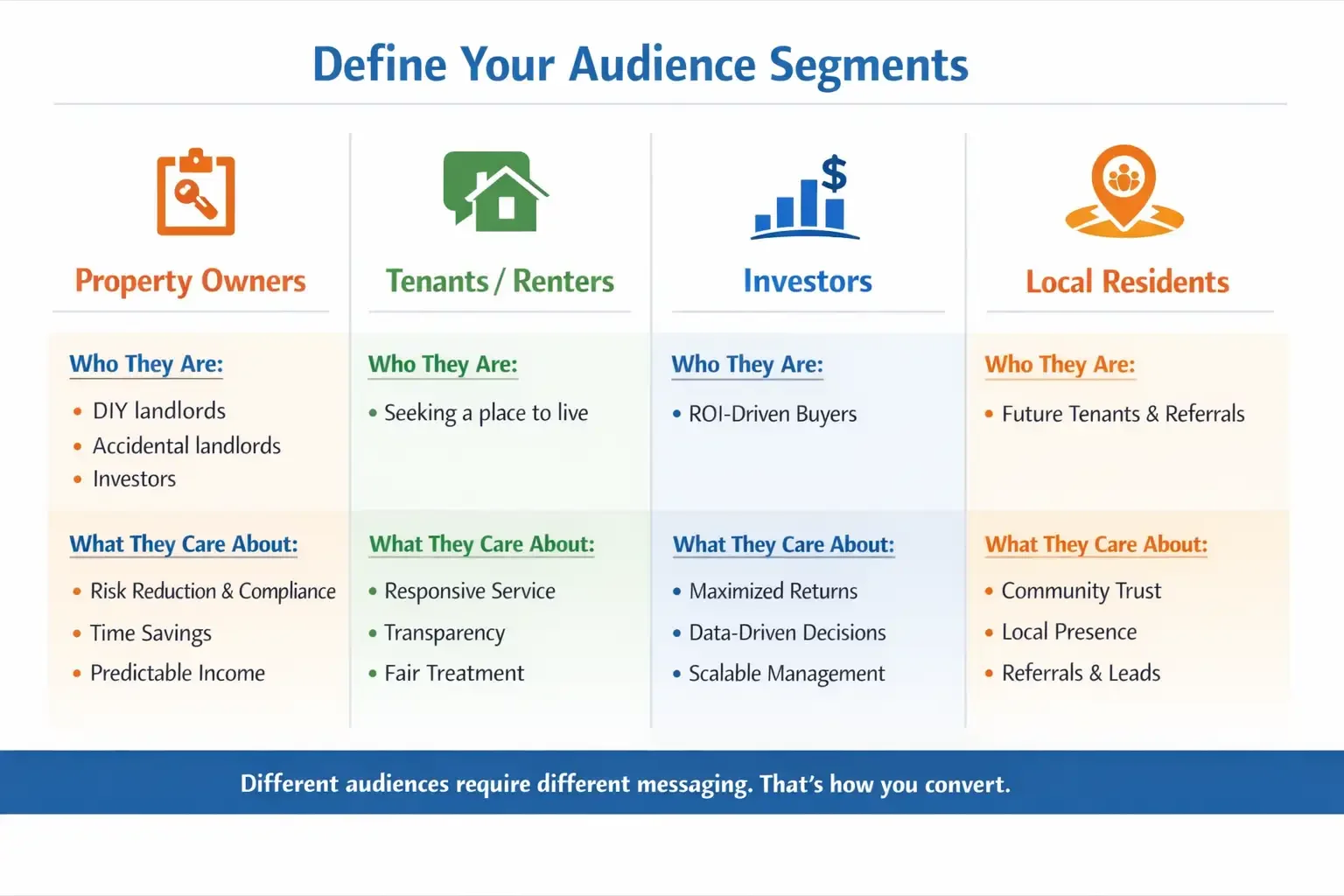
Define Your Audience Segments
Property Owners: DIY landlords, accidental landlords, investors.
Tenants/Renters: Seeking responsive, transparent services.
Investors: Looking for ROI-driven management partners.
Local Residents: Future tenants and referral sources.
Choose Effective Content Formats
Blog Posts: Evergreen guides, local insights, FAQs.
Short-Form Videos: TikToks, YouTube Shorts, Reels (e.g., “3 tenant tips”).
Email Campaigns: Automated onboarding, seasonal updates.
Social Media: Community engagement, property features.
Lead Magnets: Free checklists, local market reports.
SEO Landing Pages: Area-specific and service-specific.
2026 Content Themes & Ideas That Convert
Owner-Focused
“Top 5 Mistakes New Landlords Make (and How to Avoid Them)”
“What to Expect from a Professional Property Manager in 2026”
“How Preventative Maintenance Saves You Thousands”
Tenant-Focused
“Security Deposit Explained: What’s Deducted & Why”
“Top 10 Maintenance Issues (and How to Report Them Fast)”
“How to Renew Your Lease Online in 2026”
Local SEO-Driven
“Best Neighborhoods in [Your City] for Young Professionals”
“2026 Rental Market Update: [City/Region] Breakdown”
“Your [City] Lease Laws: What Owners and Tenants Need to Know”
Tech & Tools
“How We Use Smart Tech to Simplify Rentals”
“Online Portals: Pay Rent, Request Repairs & Communicate Instantly”
“AI in Property Management: What It Means for Owners and Tenants”
Optimize for SEO, AEO & VSO
SEO Best Practices
Geo-specific long-tail keywords: “Best property manager in Sacramento 2026”
Optimized metadata: titles, descriptions, headers
Fast, mobile-friendly website
Internal linking and sitemap updates
Voice Search Optimization: Use natural questions in your content (e.g., “How do I find a reliable property manager near me?”)
AEO (Answer Engine Optimization)
Use direct answers for PAA (People Also Ask) boxes.
Add structured data/schema for FAQs, reviews, and how-tos.
Incorporate NLP-friendly headings and subheadings.
Voice Search (VSO) Tips
Include natural, spoken questions and answers.
Create “How-to” guides and local-based FAQ content.
Aim for featured snippets using concise, paragraph-style answers.
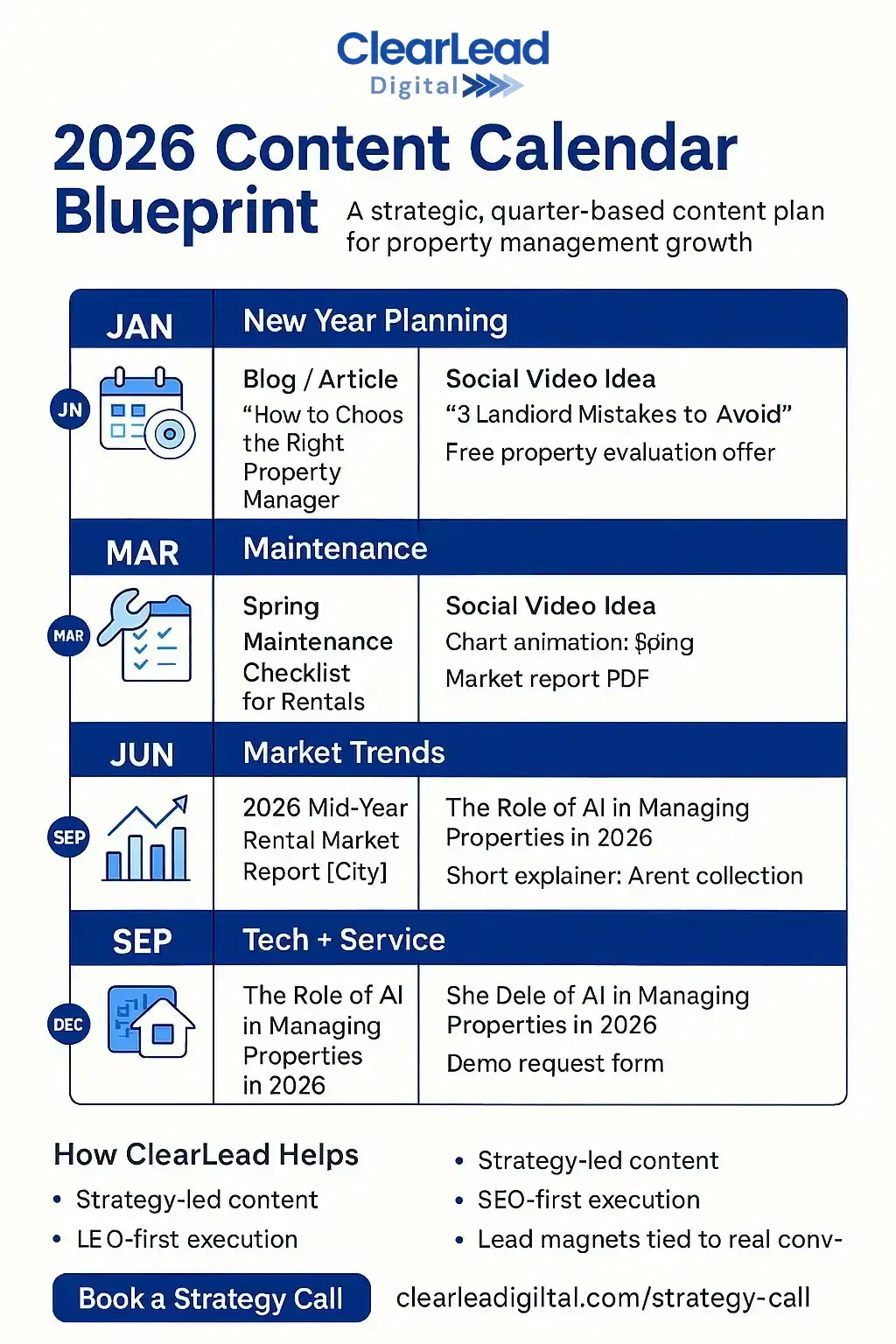
Quarterly Property Management Content Calendar
Align blog content, short-form video, social media, and downloadable resources around the seasonal questions landlords and property owners are already asking.
| Quarter | Blog Focus | Social / Video | Lead Magnet |
|---|---|---|---|
| Q1 January–March | New-Year Landlord Tax and ROI Guides Help owners evaluate rental performance, expenses, deductions, cash flow, and investment goals for the year ahead. | “3 Tenant Tips” Reels Publish short videos covering tenant screening, lease compliance, communication, rent collection, and resident retention. | Rent-vs.-Sell Calculator Give property owners a practical way to compare projected rental income with a potential home sale. |
| Q2 April–June | Leasing-Season Neighborhood Guides Target high-intent local searches with neighborhood, lifestyle, school, commute, and rental-demand content. | Property Tour Shorts Showcase available rentals, neighborhood features, upgrades, and leasing highlights through concise video tours. | Local Rental Market Report Package rental rates, vacancy trends, leasing activity, and local market insights into a downloadable report. |
| Q3 July–September | Preventative Maintenance and Turnover Educate landlords on inspections, seasonal maintenance, vacancy reduction, make-ready costs, and turnover planning. | Behind-the-Scenes Operations Clips Show inspections, vendor coordination, maintenance workflows, leasing preparation, and day-to-day property management systems. | Landlord Maintenance Checklist Offer a practical checklist covering recurring, seasonal, and turnover-related maintenance responsibilities. |
| Q4 October–December | 2027 Outlook and Renewal Campaigns Prepare owners for the coming year with rental forecasts, renewal strategies, budgeting guidance, and portfolio planning. | Owner Testimonial Videos Build trust with authentic stories from landlords and investors who have experienced measurable results. | Year-End Owner Statement Guide Explain how owners can review income, expenses, maintenance, distributions, and year-end property performance. |
Lead Generation & Conversion Strategy
Create separate landing pages for tenants vs landlords.
Offer free resources (guides, calculators, webinars) in exchange for emails.
Use live chatbots to answer FAQ and qualify leads.
Showcase testimonials and case studies.
Run local Facebook and Google PPC campaigns targeting property owners.
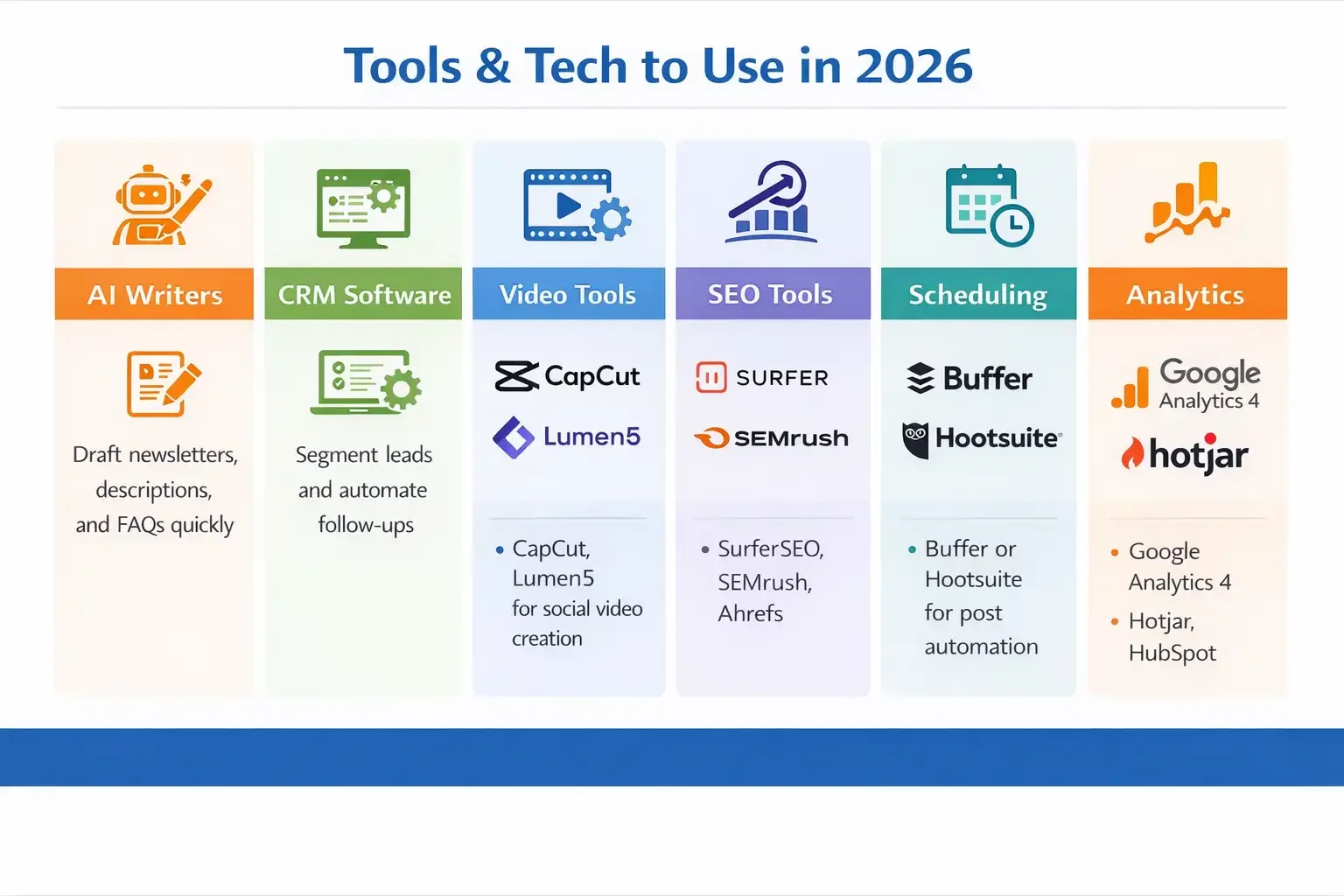
Tools & Tech to Use in 2026
AI Writers: Draft newsletters, descriptions, and FAQs quickly.
CRM Software: Segment leads and automate follow-ups.
Video Tools: CapCut, Lumen5 for social video creation.
SEO Tools: SurferSEO, SEMrush, Ahrefs.
Scheduling: Buffer or Hootsuite for post automation.
Analytics: Google Analytics 4, Hotjar, HubSpot.
Metrics That Matter
Traffic Growth: Monthly organic sessions and bounce rate.
Lead Generation: Number and source of landlord inquiries.
Conversion Rate: Lead → signed agreement ratio.
Retention: Tenant renewal and owner retention.
Engagement: Social shares, video views, email open rates.
Final Thoughts & Next Steps
2026 demands a content strategy that’s sharp, searchable, and scalable. By understanding your audience, staying ahead of trends, and consistently delivering value, you’ll attract and retain owners, tenants, and local partners.
Start simple: one blog, one social post, one email — then grow. With this playbook, your property management company will not only keep up — but lead the market in 2026.
Frequently Asked Questions (FAQs)
-
Tenants and property owners have entirely different motivations, concerns, and search intent. Separate landing pages allow you to tailor messaging, calls-to-action, and content offers—resulting in higher conversion rates and better lead quality.
-
High-performing resources include:
Landlord guides (pricing, laws, ROI expectations)
Rent-vs-sell or self-manage-vs-professional calculators
Market reports and rental forecasts
Educational webinars for new or out-of-state investors
The key is relevance and immediate value.
-
Chatbots:
Answer common questions instantly
Qualify leads based on ownership status, location, and intent
Route high-intent prospects to sales teams
Capture contact information after hours
This improves response time and prevents lead loss.
-
Yes. Property management is a trust-based service. Prospects want proof that:
You protect assets
You communicate well
You deliver consistent results
Testimonials and case studies reduce friction and shorten the sales cycle.
-
In 2026, the strongest channels are:
Local Facebook Ads targeting homeowners, investors, and landlords
Google PPC targeting high-intent keywords like “property manager near me” or “rental management services”
Paid ads work best when paired with strong landing pages and follow-up automation.
-
AI should assist—not replace—strategy. Use it to:
Draft newsletters and FAQs
Repurpose blog content into social posts
Speed up content production
Final review and brand alignment should always be handled by a human.
-
Look for CRMs that support:
Lead segmentation (tenant vs. owner)
Automated follow-ups and reminders
Pipeline visibility
Reporting tied to signed management agreements
CRMs like GoHighLevel or HubSpot are especially effective.
-
Avoid vanity metrics. Focus on:
Organic traffic growth
Number and source of landlord leads
Lead-to-agreement conversion rate
Owner and tenant retention
Engagement metrics tied to revenue impact
-
Consistency matters more than volume. A strong baseline is:
1 blog post per month
1–2 social posts per week
1 email per month
Scale up once systems and processes are in place.
-
Absolutely. SEO compounds over time, reduces reliance on paid ads, and positions your company as an authority in your market. When paired with local optimization and AI-aware content, it remains one of the highest-ROI channels available.
-
Start with:
One high-value blog post
One lead magnet
One email follow-up sequence
Build momentum gradually. Scalable systems outperform rushed campaigns.
Summary:
This 2026 playbook provides a step-by-step roadmap for property managers to compete in a higher-cost, higher-expectation market. It outlines audience segmentation, high-converting content themes, SEO/AEO/VSO optimization, a practical content calendar blueprint, lead generation and conversion tactics (separate tenant/owner pages, resources for email capture, chatbots, testimonials, and local PPC), recommended tools for 2026, and the growth metrics that matter most—traffic, leads, conversion rate, retention, and engagement.
Let ClearLead Digital Give Your Content a Boost!