Last Updated: August 10, 2026
Property management marketing is the set of strategies a property management company uses to attract new owner-clients, fill rental vacancies, and build brand authority in their local market. It spans digital channels (SEO, paid ads, social media, email) and offline tactics (referrals, networking, community presence), and the most effective programs run both in parallel.
This guide covers the 10 property management marketing strategies that drive the most consistent results in 2026.
Table of Contents
10 Property Management Marketing Strategies for 2026
Build a conversion-focused website — Your website is your highest-leverage marketing asset. It needs fast load times, clear calls to action, and dedicated landing pages for both owner prospects and tenant leads.
Invest in local SEO — Optimizing for "[city] property management" and related geo-modified keywords puts you in front of owners actively searching for a management company. Google Business Profile is the starting point. This is just one piece of a complete property management SEO strategy — pairing local optimization with technical health and content is what actually turns visibility into signed doors.
Create value-driven content — Blog posts, market update reports, and guides for landlords build authority and drive organic traffic from owners in the research phase.
Use email marketing to stay top of mind — A monthly newsletter to your owner roster and prospects keeps your brand present without requiring ad spend. Owners who aren't ready today become clients when their situation changes.
Leverage social media to showcase expertise — LinkedIn for owner-facing content, Facebook for local community presence, and Instagram for property showcases and tenant-facing marketing each serve a different segment.
Run targeted paid advertising — Google Ads targeting "property management [city]" and Facebook retargeting for website visitors provide immediate lead flow while organic channels build over time.
Build a referral network — Real estate agents, mortgage brokers, and real estate attorneys all regularly encounter landlords who need property management. Structured referral relationships are one of the highest-ROI lead sources in the industry.
Focus on tenant retention marketing — Reducing vacancy is as important as attracting new owners. Proactive tenant communication, maintenance responsiveness, and renewal incentives directly impact your portfolio's profitability.
Collect and showcase reviews — Google reviews are a direct ranking factor for local SEO and a primary trust signal for both owners and tenants evaluating your company. A systematic process for requesting reviews is essential.
Track performance and adjust — Property management marketing only compounds if you measure what's working. Monthly reviews of traffic, lead source, and conversion data let you double down on what's driving results.
How to Build a Property Management Marketing Plan
Knowing the strategies is the starting point. Knowing which ones to run first — and how they connect — is what separates companies that grow consistently from those that try everything and see nothing stick.
A property management marketing plan is a documented, sequenced strategy that aligns your marketing channels to a specific business goal: doors added, vacancy rate reduced, or management agreements signed. It's not a list of tactics. It's a system with an order of operations.
The four phases of an effective property management marketing plan:
Phase 1 — Foundation (Month 1–2) Before any marketing channel can perform, the fundamentals need to be in place. This means a conversion-ready website with clear owner-facing calls to action, a fully optimized Google Business Profile, consistent NAP citations across directories, and a review acquisition process that runs automatically after every positive owner interaction. Without this foundation, traffic from any channel converts poorly.
Phase 2 — Visibility (Month 2–4) With the foundation set, the focus shifts to getting in front of the right audience. Local SEO targeting "[city] property management" and owner-intent keywords, content marketing around landlord education topics, and a structured referral program with real estate agents are the three highest-ROI visibility channels for property management companies at this stage. Paid advertising can supplement this phase for faster results but should not replace organic visibility — it stops the moment the budget stops.
Phase 3 — Conversion (Month 3–6) Traffic without conversion is just noise. This phase focuses on ensuring that every owner who lands on your website, reads your content, or finds your Google listing has a clear and friction-free path to booking a strategy call or requesting a proposal. Email nurture sequences for leads who aren't ready to sign, retargeting ads for website visitors, and a systematic follow-up process in your CRM are the core tools here.
Phase 4 — Growth (Month 6+) Once the conversion system is working, scaling is straightforward: more content, more backlinks, expanded service area pages, and paid amplification of what's already converting organically. This is also the phase where tenant retention marketing pays dividends — every lease renewal is a vacancy you don't have to fill, and every happy long-term tenant is a signal to sophisticated owners that you run a professional operation.
What your marketing plan should include:
A primary growth goal (e.g., add 25 doors in 12 months)
Your ICP (ideal client profile) — what type of owner, what portfolio size, what market
Channel mix with monthly budget allocation
KPIs by channel: traffic, leads, calls booked, agreements signed
A 90-day sprint plan with specific deliverables by week
The companies that grow fastest aren't the ones with the biggest budgets — they're the ones with the clearest plan. A documented property management marketing plan removes the guesswork, helps your team execute consistently, and gives you a benchmark to measure against every month.
For the SEO piece of this plan specifically — how to build rankings that bring in owner leads without ongoing ad spend — see our full property management SEO guide.
Marketing a Property Management Company in 2026
The competition for owner doors has never been fiercer. In the past, property managers could rely on word-of-mouth and a basic website to grow their portfolios. Today, owners are strictly vetting management companies online before ever picking up the phone.
To win in today's local markets, your marketing strategy must be omni-channel—blending hyper-local SEO, conversion-focused web design, and high-trust content marketing that proves your operator-led expertise. Here are the most effective, ROI-driven strategies we are using right now to help PMs rapidly scale their portfolios.
Top Property Management Marketing Strategies for Growth
It doesn’t matter if you are an experienced property manager or new to the field. The right marketing strategy can help your brand, fill vacancies quickly, and grow your client base.
In today’s competitive real estate market, property management companies cannot just rely on word of mouth anymore. Owners and tenants are searching online first, comparing online reviews, websites, and professionalism long before they ever reach out. That’s why a well-crafted, data-driven marketing strategy isn’t just helpful—it’s essential for growth.
Before pitching a new owner client, make sure you can speak confidently to average property management fees in your market — it's often the first question they ask.
The most successful property management firms understand that marketing is about more than filling vacancies. It’s about building trust, authority, and visibility in the markets you serve. No matter if you manage a few units or many, the right mix of SEO, content, and reputation management can help. This approach can attract good owners, keep tenants longer, and beat local competitors.
Your marketing plan should begin with a conversion-focused website that communicates credibility, speed, and value. From there, use local SEO to take over search results in your city.
This will help you show up in Google’s Map Pack, which is one of the best places to convert online. Add in content marketing, such as blogs, FAQs, and local guides, to showcase your expertise and keep your website fresh and search-optimized.
Consistency across all channels matters. Email campaigns keep your brand in people's minds. Social media helps build engagement.
Referral programs turn happy clients into advocates. Each element plays a role in strengthening your online footprint and creating a predictable pipeline of high-quality leads. Now lets dive into this topic a little deeper.
Why Marketing Matters in Property Management
Marketing helps you:
Reach qualified landlords and investors
Fill vacancies with ideal tenants
Establish your brand as trustworthy and professional
Outperform local competition
Let’s break down the most effective strategies to market your property management business.
Build a Conversion-Focused Website
Your website is your digital storefront. Make sure it’s:
Mobile-friendly
Fast-loading
Optimized for SEO (targeting keywords like “property manager in [your city]”)
Designed with clear calls-to-action: Schedule a call, Request a quote, Owner login, etc.
Include:
Owner and tenant portals
Available rental listings with online applications
Service area pages optimized with local SEO
Invest in Local SEO
Local SEO ensures you appear when landlords or tenants search for services in your area. Key tactics:
Optimize your Google Business Profile
Get listed on local directories (Yelp, Angi, Zillow, etc.)
Use geo-targeted keywords
Encourage and respond to Google reviews
Showing up in the “Map Pack” can drive a massive amount of leads from nearby searches.
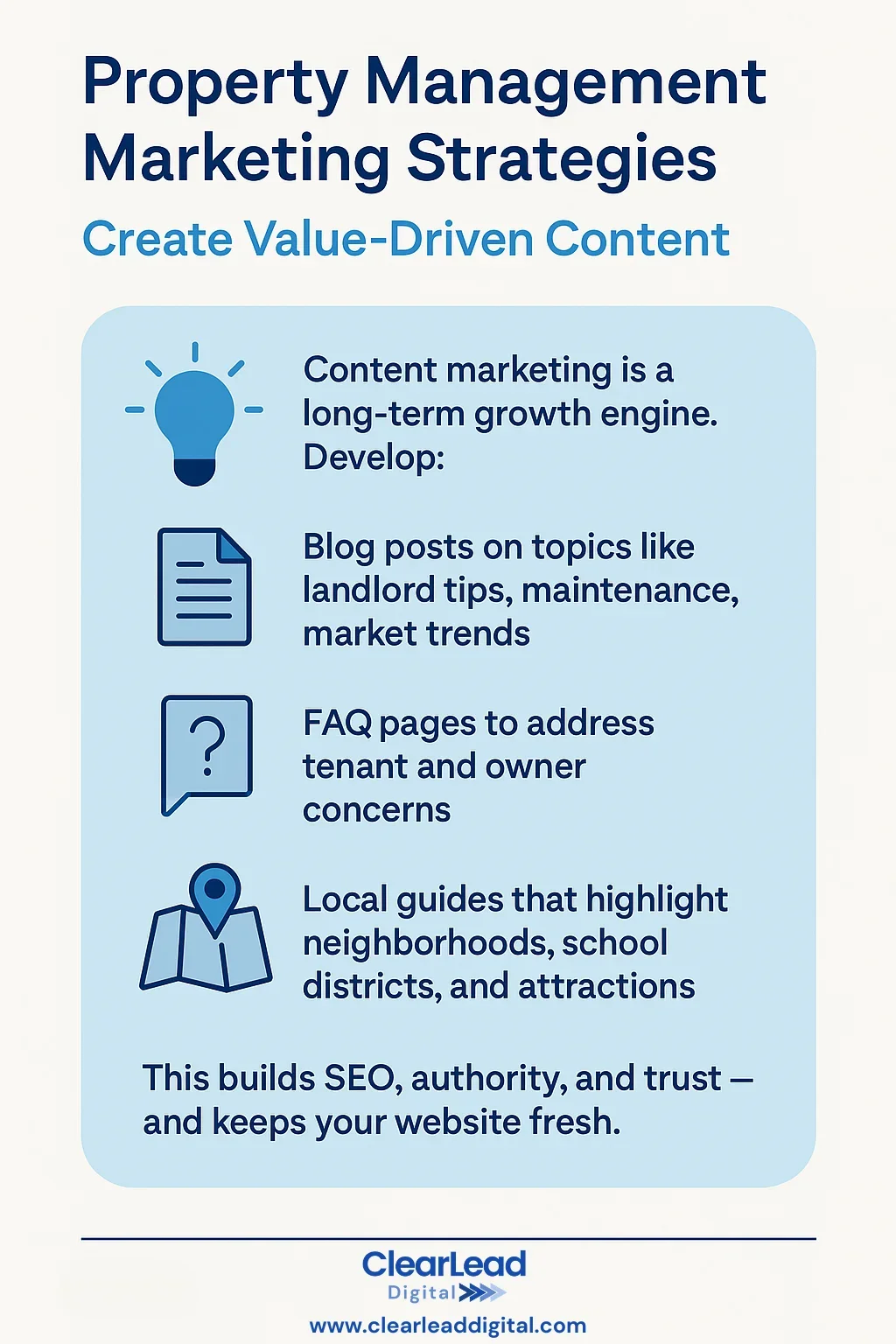
Create Value-Driven Content
Content marketing is a long-term growth engine. Develop:
Blog posts on topics like landlord tips, maintenance, market trends
FAQ pages to address tenant and owner concerns
Local guides that highlight neighborhoods, school districts, and attractions
This builds SEO, authority, and trust — and keeps your website fresh.
Use Email Marketing to Stay Top of Mind
Send regular updates to owners, tenants, and leads with:
Monthly newsletters
Market insights
Tips for investors or renters
Promotions or referral programs
Use automation to follow up with leads who request more info or download resources.
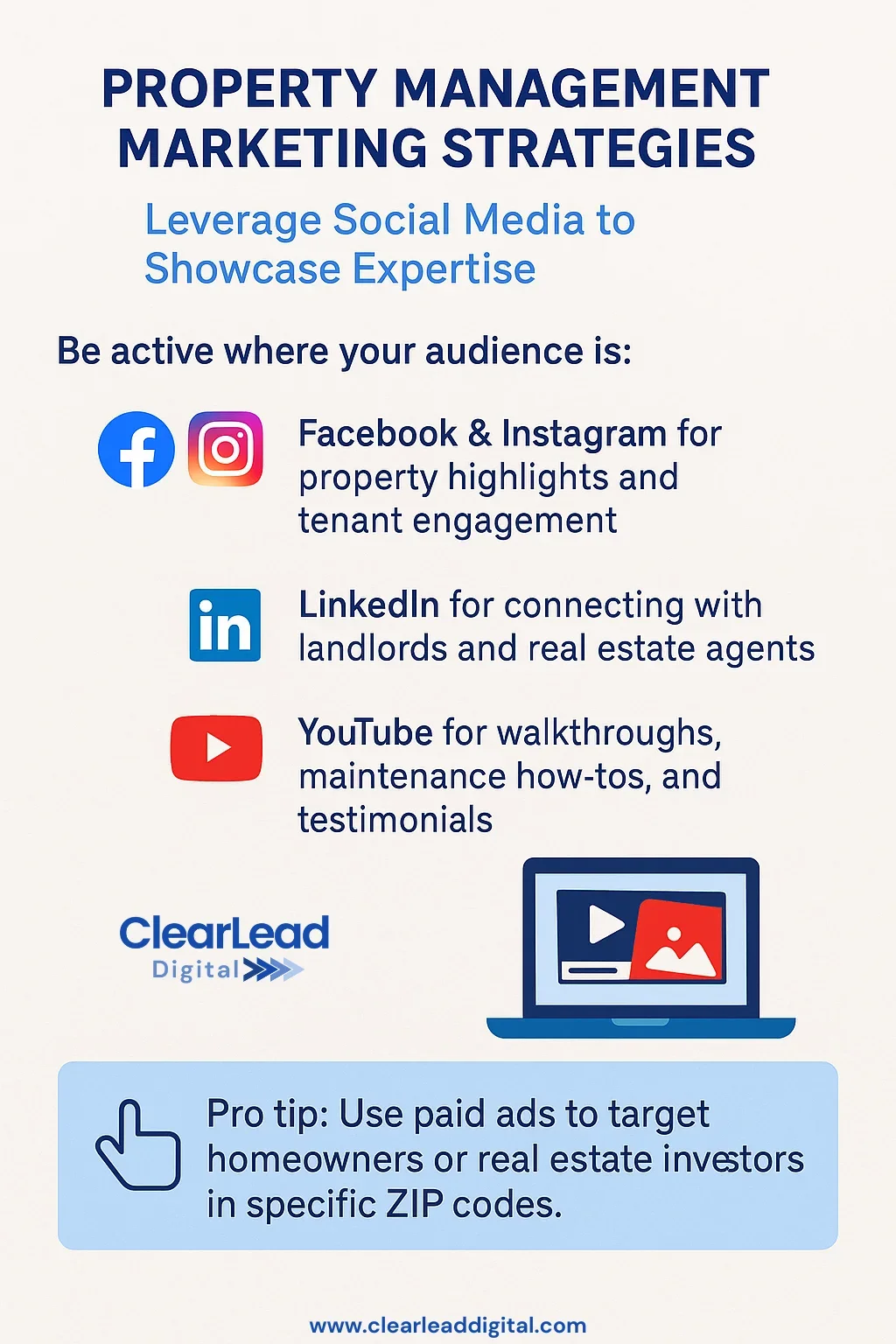
Leverage Digital Marketing & Social Media to Showcase Expertise
Be active where your audience is:
Facebook & Instagram for property highlights and tenant engagement
LinkedIn for connecting with landlords and real estate agents
YouTube for walkthroughs, maintenance how-tos, and testimonials
Pro tip: Use paid ads to target homeowners or real estate investors in specific ZIP codes.
Curious where you rank for your top services? [Get Your Visibility Snapshot]
Build a Referral Network
One of the most powerful marketing strategies is a strong referral system.
Partner with real estate agents: Offer referral fees for owner leads
Reward current clients for recommending you
Network in local real estate groups and chambers of commerce
Happy clients are your best marketers—give them tools to promote you.
Tenant Retention Marketing: The Strategy Most Property Managers Overlook
Attracting new owners gets most of the attention in property management marketing — but keeping existing tenants is equally important to your business economics, and it's often undermarketed.
Consider the math: the average vacancy costs a property owner 1–2 months of lost rent, plus leasing fees and turnover costs. A property management company that reduces vacancy rates by improving tenant retention doesn't just make their owners happier — they differentiate themselves in a market where vacancy rate is one of the first things sophisticated owners ask about.
Tenant retention marketing tactics that work:
Renewal outreach at 90 days — Don't wait until 30 days before lease end to start the renewal conversation. Proactive outreach at 90 days gives tenants time to decide without pressure and signals that you're organized and attentive.
Maintenance responsiveness as a marketing strategy — Tenants who feel their maintenance requests are handled quickly and professionally are significantly more likely to renew. Track your average maintenance response and resolution time and use it as a proof point in your owner marketing — "our tenants stay an average of [X] years."
Renewal incentives — A minor rent reduction, a new appliance upgrade, or a carpet cleaning before renewal can be far less expensive than a vacancy. Not every renewal needs an incentive, but having a framework for when to offer one avoids ad hoc decisions.
Communication touchpoints between renewals — A simple quarterly check-in (even by email) keeps the relationship warm and surfaces issues before they become move-out motivators. Tenants who feel like a valued customer rather than a rent check are more likely to stay.
Move-out surveys — When tenants do leave, a brief exit survey (even 3 questions) helps you understand whether the departure was avoidable and what could be improved. This data informs your retention strategy over time.
How to market tenant retention to owner prospects:
Owners care deeply about vacancy rates, and most property management marketing focuses entirely on acquisition. If you can say — and substantiate — that your average tenant stays [X] months longer than the market average, or that your renewal rate is [X]%, that's a competitive differentiator far more powerful than any general marketing claim. Build it into your sales process, your website's owner-facing pages, and your listing on directories like Buildium's marketplace and NARPM.
Track Performance and Adjust
You can’t improve what you don’t measure. Track:
Website traffic (via Google Analytics)
Lead conversions
Cost per lead
Source of your best tenants and owners
Use this data to refine your messaging, channels, and budget.
Expert Property Management Marketing Strategies for Growth
To grow your property management business, you need more than just marketing. You need a clear strategy based on data, authority, and consistency. Successful companies mix old-fashioned relationship-building with new digital marketing. This helps them lead their local markets and attract quality owner leads.
Start by viewing your website as a living, measurable asset. Every page should have a purpose: to educate, convert, or retain. Use SEO tools like Semrush or Google Search Console. These tools help you find the search terms that landlords and investors use.
Then, optimize your content for those keywords. Write blog posts regularly about topics that matter to owners. Focus on issues like tenant retention and legal compliance. Include local search terms to boost your authority.
Don’t overlook the power of video marketing. A short, professional video that explains your process or shows a success story can do better than static ads. This is especially true on YouTube and social media platforms.
Next, build marketing automation workflows that nurture leads over time. A simple three-step process can turn cold inquiries into long-term clients.
First, send a welcome email. Next, follow up with educational content. Finally, offer a consultation.
Finally, leverage reputation marketing. Collect and show real Google reviews. Highlight testimonials using graphics or videos. Respond to all feedback publicly to build trust.
Bonus Tips
Use professional real estate photography for listings
Invest in Google Ads or Facebook Ads to generate leads fast
Create downloadable guides (e.g., “How to Choose a Property Manager”) as lead magnets
Property Management Marketing Tools: What to Use in 2026
You don't need a large marketing budget to execute a strong property management marketing program — but you do need the right tools. Here's what most successful property management companies are using:
| Tool | Category | Best For | Approx. Cost |
|---|---|---|---|
| Google Business Profile | Local SEO | Map pack visibility, reviews, local discovery | Free |
| SEMrush / Ahrefs | SEO & keyword research | Tracking rankings, finding content opportunities, auditing your site | $120–$200/mo |
| BrightLocal | Local SEO & citations | Citation management, review monitoring, local rank tracking | From $39/mo |
| Mailchimp / ActiveCampaign | Email marketing | Owner newsletters, drip sequences, lead nurturing | From $0–$30/mo |
| Meta Ads Manager | Paid social | Facebook & Instagram ads targeting local property owners | Ad spend + free platform |
| Google Ads | Paid search | Capturing high-intent “property management [city]” searches | Ad spend + free platform |
| AppFolio / Buildium | Property management software | Owner portals, maintenance tracking, financial reporting — also marketing credibility | $250–$500+/mo |
| Canva | Design | Social media graphics, owner presentation decks, marketing materials | Free / $15/mo Pro |
| Podium / Birdeye | Review management | Automating review requests via SMS after key touchpoints | From $300/mo |
The minimal effective stack for a growing property management company: Google Business Profile (free), one email marketing tool, a basic SEO tracking setup, and a consistent process for requesting Google reviews. Everything else builds on top of this foundation.
Final Thoughts: Consistency Wins
Effective property management marketing is all about consistency and value. If you want to attract more rental owners, keep tenants, or build brand awareness, a smart marketing plan can help you stand out.
FAQ: Frequently Asked Questions
-
A good property management marketing strategy combines a website that drives conversions, local SEO, and content marketing. It also includes referral programs, email automation, and smart social media use to attract and convert owners and tenants.
-
Local SEO helps property managers get better rankings in local search results. This includes optimizing Google Business, directory listings, and Google reviews. It also helps them appear in Google’s Map Pack, bringing in more qualified local leads.
-
Email marketing helps leads and clients with regular newsletters and market insights. It also includes automated follow-ups, like for lead magnets. This keeps your brand in their minds and improves conversion rates over time.
-
Social platforms like Facebook, Instagram, LinkedIn, and YouTube help show listings and engage tenants. They also help build authority. You can use paid ads to target local homeowners.
-
Use tools like Google Analytics and CRM tracking to check website traffic and conversion rates. Look at cost per lead and channel performance. Then, adjust your messages, budgets, and channels based on this data.
-
Referrals are highly valuable. Partnering with agents, incentivizing client referrals, and participating in local networks generates steady, high-quality leads with minimal acquisition cost.
-
Property management marketing is the combination of strategies a property management company uses to attract property owners as clients, fill vacancies with qualified tenants, and build brand authority in their local market. It typically includes digital marketing (SEO, paid ads, email, social media), local SEO and citation management, referral programs, and tenant retention tactics. Effective property management marketing treats owner acquisition and tenant retention as two parallel priorities rather than focusing exclusively on one.
-
Property management companies typically acquire new owner-clients through a combination of local SEO (ranking for "[city] property management" searches), referrals from real estate agents and brokers, Google Business Profile visibility and reviews, paid advertising on Google and Facebook, and word-of-mouth from existing satisfied owners. The most effective programs combine inbound channels (SEO and content that attract owners when they're searching) with outbound channels (referral relationships and targeted advertising). Organic search tends to produce the highest-quality leads over time because it captures owners at the exact moment they're actively looking for help.
-
The single highest-ROI property management marketing strategy for most companies is local SEO — specifically, ranking in Google's map pack for "[city] property management" and related searches. When done well, this produces a consistent stream of inbound owner leads without ongoing ad spend. The second most effective strategy is building structured referral relationships with real estate agents, who regularly encounter landlords who need management services. These two channels alone — local SEO and agent referrals — drive the majority of new business for most top-performing property management companies.
Want Expert Help?
If you want to improve your marketing but don’t know how, think about working with a expert team. They should know about real estate SEO, local search, and property management branding. Contact ClearLead Digital for ethical and transparent property management marketing.